

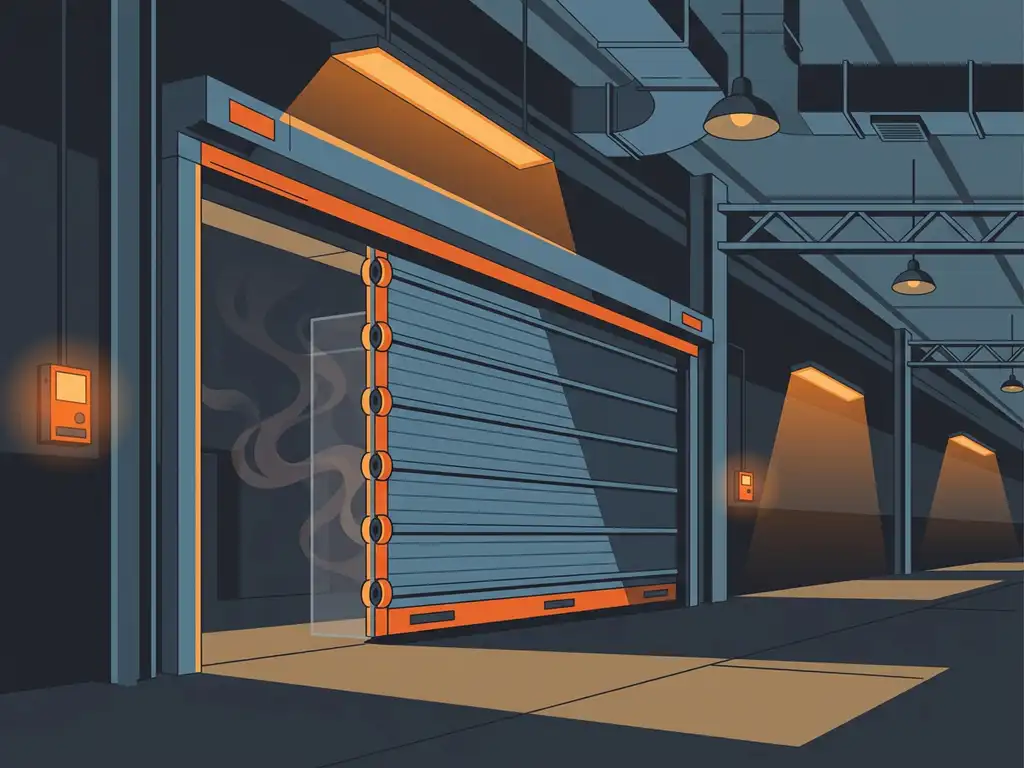
A fire-rated high-speed door is a rapid-opening industrial door that also provides certified fire resistance, allowing it to serve as a fire compartment barrier in locations where throughput cannot be interrupted. It combines the operational speed of a standard high-speed door with the passive fire protection function of a fire door, making it relevant for production halls, logistics centres, and warehouses where forklifts or automated transport systems pass through fire compartment boundaries continuously.
Unlike a conventional fire door that stays closed and opens only on demand, a fire-rated high-speed door operates in normal mode at full speed and closes automatically when a fire signal is received. The sections below address the most common specification questions architects and fire safety engineers encounter when evaluating this product type.
How does a high-speed door achieve fire resistance?
A fire-rated high-speed door achieves fire resistance through a combination of certified materials, a controlled closing mechanism triggered by fire detection, and a construction that meets the requirements of EN 1634-1 — the European test standard for the fire resistance of door assemblies. The door must maintain its integrity and, depending on classification, limit heat transfer for a defined period under standardised fire exposure conditions.
In practice, this means the curtain or panel material must be capable of withstanding high temperatures without collapsing or allowing flame passage. The guiding tracks, bottom seal, and side seals are engineered to remain functional under thermal stress. Critically, the door must reach its fully closed position reliably and within a defined time when triggered, because a fire-rated door that fails to close provides no protection at all.
The closing sequence is typically gravity-assisted or spring-driven, meaning a power failure does not prevent closure. This fail-safe behaviour is a fundamental requirement for certification under EN 1634-1, and any door claiming fire resistance must demonstrate it through independent testing rather than manufacturer self-declaration. Metacon-Next’s fire-rated door range is tested by Efectis, an accredited European fire testing laboratory, which provides the classification reports needed for specification and permitting.
What fire resistance classifications apply to high-speed doors?
Fire-rated high-speed doors are classified under EN 13501-2, the European standard for the fire resistance of construction products including doors. The applicable classifications are EW and EI — each defined by a time period in minutes.
E (integrity) means the door stops flames and hot gases from passing through. W (radiation reduction) means the door additionally limits radiant heat transfer to the unexposed side — this is the Dutch standard baseline criterion for fire-resistant industrial doors. EI means the door additionally limits the temperature rise on the unexposed face; the insulation criterion always requires one of two explicit suffixes:
- EI2 — the less strict insulation criterion: a higher temperature rise on the unexposed side is permitted
- EI1 — the stricter insulation criterion: temperature rise on the unexposed side is limited to a lower threshold
Never use “EI” without specifying EI1 or EI2 — the distinction is technically and legally significant when specifying doors for a fire compartment boundary.
For high-speed doors specifically, the achievable classification depends heavily on the door’s construction and the tested configuration. Not all high-speed door designs can achieve EI classifications — some are limited to EW. The classification is always tied to the tested product in its tested configuration, including maximum dimensions, frame type, and installation conditions. Specifying beyond the tested parameters is not permitted under CE marking rules.
Common classifications seen in industrial applications are EW 60, EI2-60, and EI2-90. The required classification for a specific opening is determined by the project’s fire safety calculation, not by a blanket rule based on building type. Whether a given classification is sufficient for a particular compartmentalisation requirement depends on a project-specific assessment — consult a qualified fire safety engineer or Metacon-Next directly for guidance on your specific situation.
When is a fire-rated high-speed door required instead of a standard fire door?
A fire-rated high-speed door is appropriate when a fire compartment boundary must remain passable at high frequency and a standard fire door would create an operational bottleneck. Standard fire doors are designed to be kept closed; they open on demand and return to the closed position. In environments with continuous forklift traffic, automated guided vehicles, or conveyor-integrated openings, a door that is perpetually cycling like a standard fire door creates unacceptable delays and mechanical wear.
The decision to use a fire-rated high-speed door rather than a standard fire door is therefore an operational one, but it must be validated against the fire safety calculation for the project. The fire safety engineer determines what classification is required at the opening; the architect or specifier then selects a product type that achieves that classification while meeting the operational requirements of the building.
Typical scenarios where this product type is specified include:
- Logistics centres with automated sorting lines crossing compartment walls
- Production facilities where forklifts move between fire compartments multiple times per hour
- Cold storage operations where standard fire doors would compromise thermal performance
- Cleanroom or controlled-environment areas where a permanently closed door is incompatible with process flow
Where throughput is low and the opening can remain closed between uses, a standard fire door remains the simpler and often more cost-effective solution. The fire-rated high-speed door addresses a specific operational constraint, not a general preference.
What’s the difference between a fire-rated high-speed door and a standard high-speed door?
The key distinction is certification and fire behaviour. A standard high-speed door is engineered for speed, durability, and energy efficiency, but it carries no fire resistance classification and cannot serve as a fire compartment barrier. A fire-rated high-speed door is designed to the same operational speed requirements but is additionally tested and certified under EN 1634-1, meaning it has a defined and proven fire resistance period.
Structurally, the differences include:
- Materials: Fire-rated curtains or panels use materials that maintain integrity under fire conditions; standard high-speed door materials are optimised for flexibility and thermal insulation but not fire resistance.
- Closing mechanism: Fire-rated doors include a fail-safe closing system that operates independently of the normal drive motor. Standard high-speed doors may have safety reversal systems but no certified fire-triggered closure.
- Integration with fire detection: Fire-rated doors must be connected to the building’s fire detection system and respond to a fire signal by closing and latching. Standard high-speed doors have no such requirement.
- Documentation: A fire-rated door comes with a classification report, CE declaration of performance, and installation requirements that define the conditions under which the certification is valid. A standard high-speed door does not.
Visually, the two product types may look similar in normal operation. The difference becomes critical at specification stage and during a building inspection or fire safety review, when the absence of a classification report on a standard high-speed door installed in a compartment boundary will result in non-compliance.
How does a fire-rated high-speed door integrate with fire detection systems?
A fire-rated high-speed door must be connected to the building’s fire detection and alarm system so that it closes automatically when a fire signal is received. This connection is not optional — it is a functional requirement for the door to fulfil its role as a fire compartment barrier. The door’s control unit receives a signal from the fire alarm panel, immediately interrupts normal operation, and initiates a controlled closure sequence.
The closing sequence is designed to be fail-safe. If power is lost during a fire, the door closes under gravity or spring tension without requiring electrical input. This behaviour is verified during the EN 1634-1 test and documented in the classification report. A door that requires power to close cannot achieve fire resistance certification.
Integration requirements that architects and specifiers should confirm during the design phase include:
- The signal protocol accepted by the door’s control unit (volt-free contact, BACnet, or other building management interface)
- The maximum response time from signal receipt to the door being fully closed — relevant for compartment design calculations
- Whether the door resets automatically after a fire alarm or requires manual reset by a qualified person
- The zoning of the fire detection system relative to the door location, to ensure the correct detector zone triggers the correct door
Coordination between the fire detection engineer and the door supplier is essential at specification stage. Installing a fire-rated door without confirming the integration interface is a common source of commissioning delays on industrial projects.
What documentation is needed to specify a fire-rated high-speed door?
To specify a fire-rated high-speed door in a permit-ready design, the following documentation must be available from the manufacturer: a CE declaration of performance, a classification report from an accredited testing laboratory, and installation requirements that define the conditions under which the classification is valid. Without all three, the product cannot be lawfully installed as a fire compartment barrier under European construction product regulations.
For industrial fire doors, two CE marking standards apply simultaneously: EN 16034, which covers fire- and smoke-resisting closing elements, and EN 13241, which applies to industrial doors generally. These standards are not interchangeable — both are mandatory and must both be addressed in the product’s CE documentation.
For projects with sustainability certification requirements such as BREEAM or LEED, an Environmental Product Declaration (EPD) is increasingly expected at specification stage. An EPD is an information document that quantifies the environmental impact of the product across its lifecycle. It is not a sustainability award or environmental label, but it provides the data required to demonstrate material transparency within a green building assessment framework.
A complete specification package for a fire-rated high-speed door should include:
- CE declaration of performance — confirms the product’s declared fire resistance classification under EN 13501-2, with reference to both EN 16034 and EN 13241 where applicable
- Classification report — the test report from the accredited laboratory (such as Efectis) documenting the fire resistance test per EN 1634-1 and its results, classified per EN 13501-2
- Installation requirements — the conditions, frame types, maximum dimensions, and fixing specifications under which the classification is valid
- EPD — lifecycle environmental data for projects requiring material transparency
- Technical drawings and dimensional data — required to confirm the door fits the structural opening and that the installation conditions match the tested configuration
Architects specifying fire-rated doors should request this documentation before committing to a product, not after order placement. A supplier who cannot provide classification reports and installation requirements at quotation stage creates risk at the permitting and inspection phase. Metacon-Next publishes certificates, classification reports, and EPDs on its website, allowing architects to verify compliance without waiting for a sales response.
For projects requiring custom dimensions or non-standard configurations, confirm that the tested configuration covers the required opening size. Classification reports are specific to the tested product in its tested dimensions; extrapolation beyond the tested range is not permitted under CE marking rules and will not be accepted during a building inspection.
If you are in the early stages of specifying a fire-rated opening for an industrial project, contact Metacon-Next directly to discuss the technical requirements and obtain the documentation needed to close your design file.
Locations where changes were made:
- Paragraph under “What documentation is needed to specify a fire-rated high-speed door?” (body paragraph) — “EN 13241-1” changed to “EN 13241” in the sentence referring to the standard that applies to industrial doors generally.
- Ordered list item 1 under the same section — “EN 13241-1” changed to “EN 13241” in the reference to both EN 16034 and EN 13241 within the CE declaration of performance description.