

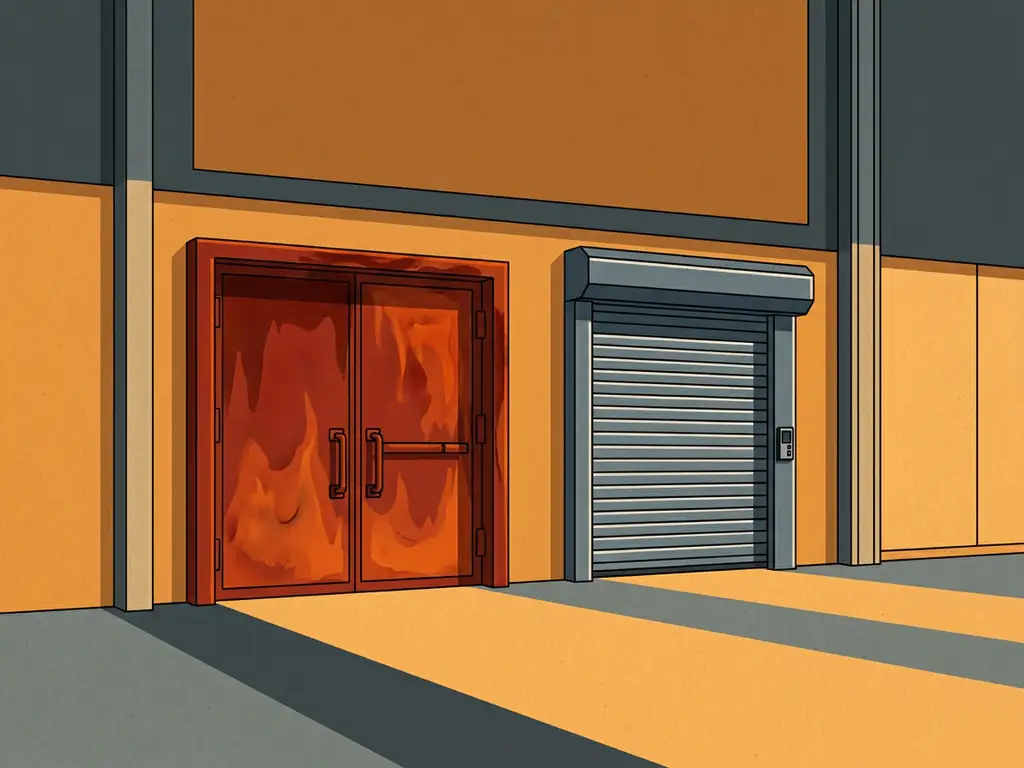
A high-speed door and a fire door serve fundamentally different purposes and cannot simply replace one another. A fire door is a passive fire protection element designed to contain smoke and flames within a defined compartment, while a high-speed door is an operational solution designed to manage traffic flow, temperature, and hygiene. The two functions are not interchangeable — though the question of which one belongs in a given opening is one that architects and facility planners face regularly in industrial projects.
The sections below address the most common questions around this distinction, including how fire resistance classifications work, when a fire door is the right specification, and what documentation a compliant product must carry.
Can a high-speed door also be a fire door?
In most cases, no. A high-speed door and a fire door are engineered for different performance criteria and are tested under different standards. A standard high-speed door is not classified as a fire-resistant product under EN 1634-1, which means it cannot legally substitute for a fire door in a compartmentation wall. Some specialist products exist that combine rapid operation with fire resistance, but these are certified separately and must carry the appropriate classification documentation before they can be specified as fire-rated elements.
The confusion is understandable. Both door types appear in large industrial openings, both can be motorised, and both are often installed in the same logistics or production environments. But from a regulatory standpoint, a product either holds a valid fire resistance classification or it does not. Specifying a high-speed door in place of a fire door — without verified classification — creates a gap in the fire compartmentation strategy that will not survive a permit review or fire safety inspection.
If an opening requires both high throughput and fire resistance, the specification must explicitly call for a product that has been tested and classified for both. Metacon-Next’s fire-rated product range includes roller doors and other door types designed for demanding industrial environments, available with full classification documentation.
What does a fire door actually protect against?
A fire door protects against the spread of fire and smoke between compartments within a building. Its function is passive: it does not suppress a fire, but it contains it. By holding back flames, heat, and combustion gases for a defined period — typically 30, 60, or 90 minutes — a fire door gives occupants time to evacuate and limits structural and material damage to the area of origin.
This containment function is what makes fire doors a legal requirement in compartmentation walls. Building regulations in the Netherlands, including the Besluit bouwwerken leefomgeving (Bbl), set minimum performance requirements for openings in fire-separating constructions. The fire door must maintain the integrity of the compartment boundary for the required duration, even under the thermal and mechanical stress of an active fire.
A fire door is also not simply a slab of steel. It includes the door leaf, frame, seals, hinges, closing mechanism, and any glazing — all of which must perform together as a tested assembly. The classification applies to the complete product as tested, not to individual components.
What is a high-speed door designed to do?
A high-speed door is designed to open and close rapidly — typically within seconds — to minimise air exchange between zones, maintain temperature or hygiene conditions, and allow continuous traffic flow in busy operational environments. Common applications include cold stores, food production facilities, logistics hubs, and production halls where forklifts or automated guided vehicles move frequently between areas.
The performance criteria for a high-speed door are entirely operational: cycle speed, opening width, resistance to wind load, and durability under high-frequency use. These are not fire resistance criteria. A high-speed door is not tested for its ability to contain fire or smoke, and its construction — typically a flexible curtain or lightweight panel system — is not designed to withstand fire exposure.
This means a high-speed door can be the right solution for managing internal climate and traffic, but it cannot serve as a fire-compartmentation element unless it carries a separate and verified fire resistance classification.
How do fire resistance classifications like EI1, EI2, and EW differ?
Fire resistance classifications describe what a door prevents from passing through it during a fire, and for how long. The three classifications most relevant to industrial door specification are EI1, EI2, and EW, and they are not interchangeable.
EI1 and EI2: insulation with different criteria
Both EI1 and EI2 classify a door on two criteria: E (integrity, meaning no flames or hot gases pass through) and I (insulation, meaning the temperature on the unexposed side remains below a defined threshold). The difference lies in how strictly the insulation criterion is measured. EI2 applies the standard European measurement method. EI1 applies a stricter measurement that limits the average temperature rise more tightly. A product classified as EI2 does not automatically meet EI1 requirements — they are separate classifications requiring separate testing.
EW: integrity with limited radiation
EW classifies a door on integrity (E) and limits the heat radiation passing through it (W), but does not require the same insulation performance as EI1 or EI2. In the Netherlands, W is the baseline criterion used in the Bbl for certain applications. EW is appropriate where the primary concern is preventing flame spread and limiting radiant heat to a safe level on the unexposed side, rather than maintaining a low surface temperature.
Which classification applies to a specific opening is determined by the project’s fire safety calculation, not by a general rule. The Bbl sets minimum requirements, but sector regulations such as PGS15, insurer requirements, or client specifications may require a higher classification. Never assume a classification is sufficient or excessive without reference to the project-specific documentation.
When should an industrial opening have a fire door instead of a high-speed door?
An industrial opening requires a fire door whenever it penetrates a fire-separating construction — a wall or floor that forms the boundary of a fire compartment. This is a regulatory requirement, not a design preference. If the structural drawing designates a wall as a fire-separating element, every opening in that wall must be closed by a product that maintains the compartment’s fire resistance for the required duration.
Common scenarios in industrial buildings where fire doors are mandatory include openings between production areas and storage zones, passages between a warehouse and an attached office building, and connections between fire compartments in logistics centres. The maximum compartment size permitted under Dutch building regulations varies by building use and construction type, and exceeding it without adequate compartmentation is a permit-level issue.
A high-speed door is appropriate where no fire-separating function is required — for example, between two spaces within the same compartment where the goal is climate control or traffic management. When both functions are needed at the same opening, the specification must call for a product that is certified for fire resistance and operationally suited to the traffic requirements. Requesting a quotation from a manufacturer with in-house R&D is the right starting point for those combined-function requirements.
What documentation should a fire door come with?
A fire door supplied for use in a regulated building opening must come with a complete documentation package. This is not optional — it is the basis on which an architect, contractor, or building inspector can verify that the product meets the specified requirements. The essential documents are the CE declaration of performance, the classification report from an accredited test laboratory, and the technical product data sheet covering the tested configuration.
For projects with sustainability requirements — BREEAM, LEED, or environmental permit conditions — an Environmental Product Declaration (EPD) is increasingly expected. An EPD is not an environmental award; it is a standardised information document that quantifies the environmental impact of a product over its life cycle. Having an EPD available at specification stage removes a common source of delay in permit-heavy or sustainability-rated projects.
One practical differentiator when evaluating manufacturers is whether this documentation is available before order placement. Some suppliers provide classification reports only after a purchase has been committed. Metacon-Next publishes certificates, classification reports, and EPDs openly, allowing architects and specification writers to verify compliance and close a design file without waiting for a sales process to conclude.
For openings that fall under specific sector regulations — PGS15 for hazardous substances storage, for example — additional documentation requirements may apply. These should be identified during the fire safety design phase, not at the installation stage.
If you are specifying fire-rated openings for an industrial project and need to verify product classifications or request technical drawings, the Metacon-Next contact page is the direct route to technical support. All products are supplied and installed through a certified dealer network, ensuring that installation quality is covered alongside the product certification itself. You can also explore the full fire-rated door range or learn more about the manufacturer’s approach on the about us page.