

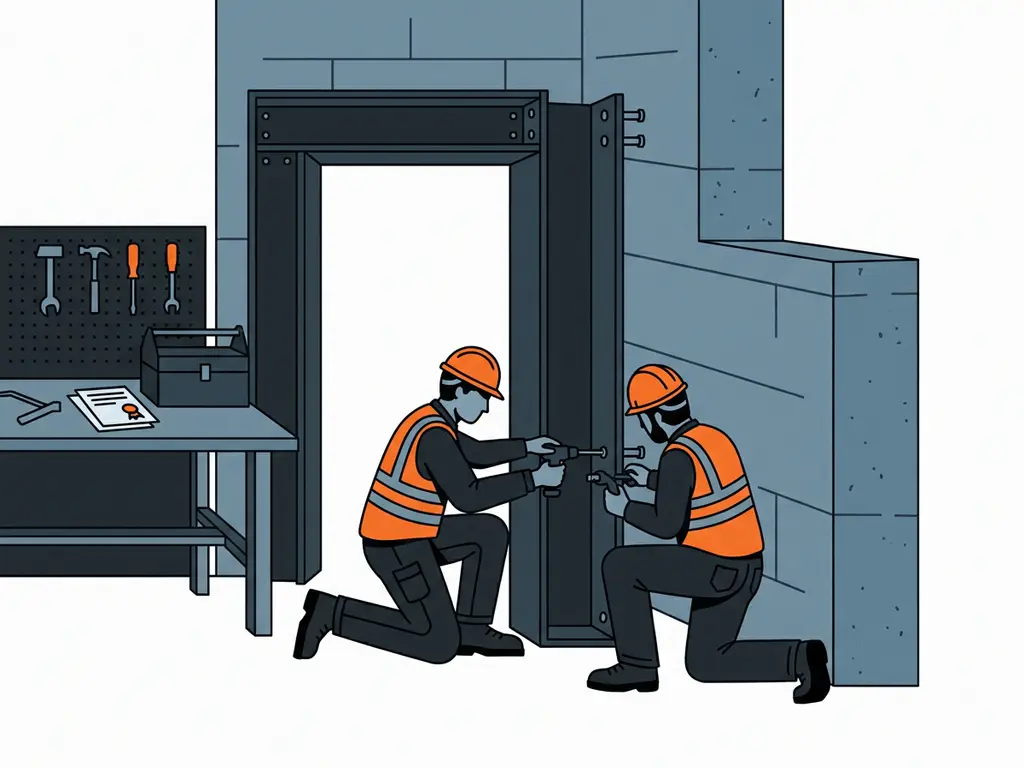
Fire-rated industrial doors must be installed by qualified professionals who hold relevant trade certifications in steel door installation, fire door assembly, or a recognized construction discipline. In most European countries, including the Netherlands, there is no single mandatory national licence specifically for fire door installation, but the installer must be able to demonstrate technical competence and work within a framework that preserves the door’s CE certification and fire resistance classification. The sections below address the most common questions architects face when specifying who may legally and safely carry out this work.
What qualifications must a fire door installer legally hold?
There is no single European or Dutch licence titled “fire door installer.” What the law requires is that the installation is carried out in a way that maintains the product’s certified performance. In practice, this means the installer must follow the manufacturer’s installation instructions precisely, work within the scope of the CE declaration of performance, and be able to demonstrate relevant trade competence, typically through a recognized vocational qualification in metalwork, steel construction, or industrial door installation.
In the Netherlands, the BBL (Besluit Bouwwerken Leefomgeving) sets the absolute minimum performance requirements for fire-separating constructions, but it does not prescribe who may install them by name. What it does require is that the installed product continues to meet the classified performance — whether that is EI1-60, EI2-90, EW60, or whichever classification the project’s fire safety calculation demands. Which classification applies to a specific opening depends on that project-specific calculation, not on a fixed universal rule; for guidance on your project, consult a qualified fire safety engineer or contact Metacon-Next directly. If the installation deviates from the manufacturer’s approved method, the classification is no longer valid, regardless of the installer’s credentials on paper.
For architects specifying fire-rated openings, the practical implication is this: the installer’s qualifications matter less than their demonstrable familiarity with the specific product and its installation requirements. A general contractor with broad construction experience but no knowledge of fire door assembly is not an adequate substitute for a specialist installer who has been trained on the product in question.
What’s the difference between a certified installer and an approved installer?
A certified installer holds a formal third-party certification from an independent body confirming that they meet defined competence standards for a specific scope of work. An approved installer is typically designated by a manufacturer as authorized to install and, where relevant, warrant their products. These are not the same thing, and confusing them creates specification risk.
In the fire door sector, manufacturer approval is the more operationally significant of the two. When a manufacturer trains and approves an installer, they are confirming that the installer understands the product’s construction, the tolerances required for the frame and leaf, the correct anchoring method, and the sealing requirements that determine fire resistance performance. Fire resistance classification — for example EW60 (integrity and radiant heat limitation for 60 minutes, the Dutch standard baseline criterion) or EI2-90 (integrity and insulation to the less strict criterion for 90 minutes) — is only meaningful if the installation itself conforms to the documented method on which that classification was tested and certified. Without that product-specific knowledge, even a broadly certified tradesperson may inadvertently void the classification.
Third-party installer certification schemes do exist in some markets and provide an additional layer of assurance. Where such schemes are available, they typically assess the installer’s general competence across a range of fire door types rather than for a specific product. For architects, the most defensible position is to specify that installation must be carried out by an installer who is both competent in the relevant trade and approved by the door manufacturer for that product line.
Does the door manufacturer determine who can install their products?
Yes, in a meaningful practical sense. The CE declaration of performance for a fire-rated door is tied to the product as manufactured and as installed according to the manufacturer’s documented method. For industrial fire doors, CE marking is governed simultaneously by EN 16034 (for the fire- and smoke-resisting closing function) and EN 13241 (for the industrial door product category generally) — both apply at the same time. If installation deviates from the manufacturer’s approved method, the declaration no longer covers the installed product. This gives manufacturers significant control over who can credibly install their doors while maintaining the certified performance.
Metacon-Next, for example, supplies its fire-rated industrial doors exclusively through a network of certified dealers and installers. This is not a commercial restriction — it is a quality and liability framework. Every installer in the network has been trained on the product and is equipped to install it in accordance with the Efectis classification reports and installation documentation that underpin the CE certificates. When an architect specifies a Metacon-Next product, the installation route is already structured to preserve the fire resistance classification from day one.
This model also simplifies the architect’s specification task. Rather than separately specifying product and installer qualifications, the manufacturer’s dealer network effectively bundles both. The product and the installation are warranted together, which reduces the risk of a gap appearing between what was specified and what was delivered on site.
How can an architect verify that an installer is competent?
Verification should focus on three areas: product-specific training, documented installation experience, and the availability of post-installation documentation. An architect should request evidence that the installer has been trained or approved by the door manufacturer, can provide references for comparable fire door installations, and will supply a signed installation declaration or handover document confirming the work was carried out in accordance with the manufacturer’s instructions.
For projects subject to a building permit or fire safety review, this documentation is not optional. The authority reviewing the permit or conducting a fire safety inspection will expect to see that the installed products match the specified classification and that the installation was carried out correctly. An installer who cannot produce training records or a manufacturer approval letter creates a documentation gap that falls back on the specifying architect.
Working with manufacturers who operate a structured dealer network removes much of this verification burden. When you source a product through Metacon-Next, the installer is already part of a vetted network — you do not need to independently audit their credentials. For architects working across multiple projects or geographies, this consistency is a practical advantage that saves time during specification and reduces liability exposure during construction.
If you are working on a project where the installer is not part of a manufacturer network, ask directly: Has this installer installed this specific product before? Can they provide the manufacturer’s installation manual and confirm they will follow it? Can they provide a signed declaration on completion? These three questions surface most competence gaps before they become site problems.
What happens if a fire door is installed by an uncertified party?
If a fire door is installed by a party who is not approved or trained by the manufacturer, and the installation does not conform to the documented method, the CE declaration of performance is effectively invalidated for that installation. The door may still look correct and function mechanically, but its classified fire resistance — EI1-60, EI2-90, or otherwise — cannot be assumed to hold under fire conditions. This has direct legal, insurance, and liability consequences.
From a regulatory standpoint, a building with fire compartmentation that relies on non-conforming installations does not meet the minimum performance requirements of the BBL, even if the specified product itself was compliant. During a fire safety inspection or a post-incident investigation, the installation method will be scrutinized. If it cannot be demonstrated that the installation followed the manufacturer’s approved procedure, the building owner, contractor, and potentially the specifying architect may face liability.
Insurance implications are equally serious. Many property and liability insurers require that fire-rated elements be installed in accordance with their certification. A non-conforming installation can void coverage for fire damage, which is a risk that no client or contractor wants to carry.
The straightforward way to avoid this outcome is to specify from the outset that installation must be carried out by a manufacturer-approved installer, and to document that requirement in the tender specification. Manufacturers like Metacon-Next structure their dealer and installer network precisely to close this gap, ensuring that the product’s certified performance is preserved through to the completed installation.
If you are preparing a specification or have questions about installer requirements for a specific project, the Metacon-Next team can provide guidance on which certified installers operate in your region and what documentation will be available at handover. You can also request a quotation that includes installation through the certified dealer network, so the full scope is covered from the start.
Related Articles
- What is the role of a certified dealer in fire door supply and installation?
- How does an industrial door dealer network operate?
- Is express delivery available for certified fire-rated doors?
- How far in advance should industrial doors be ordered for a new build?
- Is it possible to combine high-speed doors with fire resistance?