

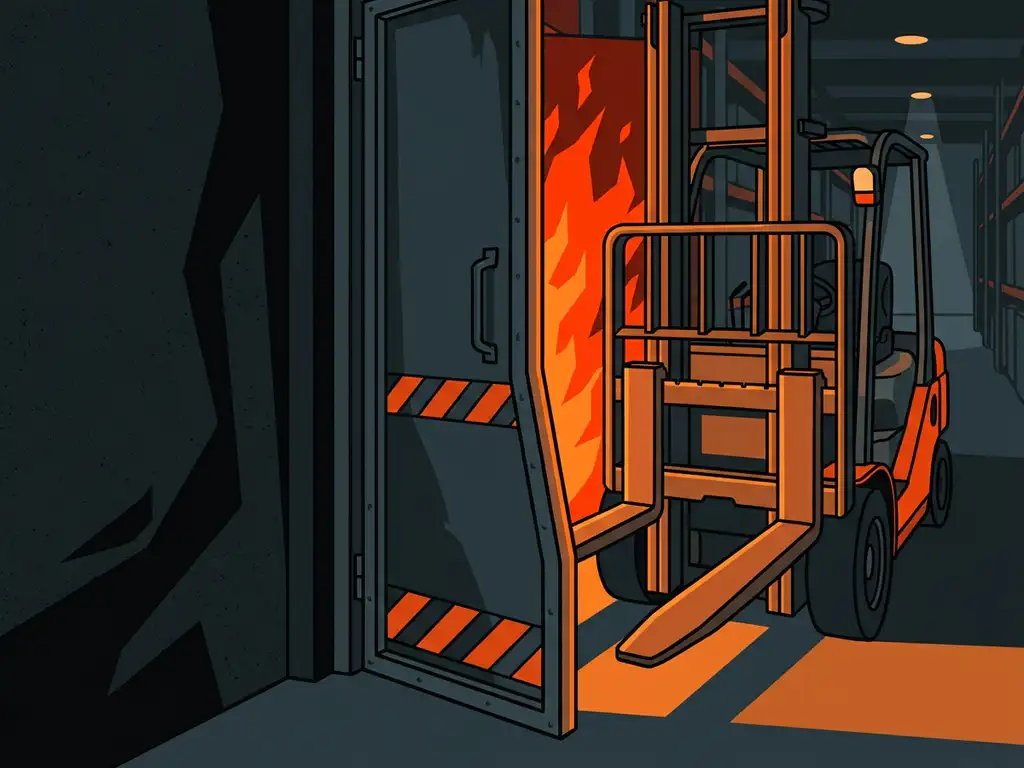
A fire door can stay open during forklift operations, but only if it is held open by an approved, fire-alarm-linked hold-open device. Propping a fire door open manually, with a wedge, or with any unapproved mechanism immediately voids the door’s certification and creates a direct violation of passive fire protection requirements. The sections below address the legal, technical, and specification questions that arise when designing a fire-rated opening for high-traffic industrial passages.
What happens to a fire door’s certification if it’s held open manually?
Holding a fire door open manually, or with an improvised stop such as a wedge or chain, renders the door non-compliant at that moment and effectively voids its certification for the duration it remains propped open. A CE-certified fire door is tested and classified as a complete, self-closing assembly. The self-closing mechanism is not an optional feature; it is a tested component of the system. Remove or bypass it, and the classification no longer applies.
From a liability perspective, this matters enormously. If a fire occurs while the door is propped open, the compartmentation it was designed to provide does not exist. Insurance claims can be denied, and the responsible party, whether the facility manager or the contractor, may face legal consequences. Architects specifying fire doors for industrial environments where manual propping is a foreseeable operational habit should address this explicitly in the specification and in the handover documentation.
The practical implication is straightforward: if an opening needs to remain passable during working hours, the solution is not to prop the door open. The solution is to specify a door with a compliant hold-open system that releases automatically on alarm.
Are there approved devices that allow a fire door to stay open legally?
Yes. Electromagnetic hold-open devices, when correctly integrated with the building’s fire alarm system, allow a fire door to remain open during normal operations while ensuring it closes automatically the moment the alarm activates. These devices are a recognised and tested solution under European standards, and their use does not void the door’s fire resistance classification, provided the entire assembly — including the hold-open device — is covered by the relevant test evidence and CE declaration.
The key requirement is integration. The hold-open device must be wired to the fire detection system so that any alarm signal triggers immediate release. A device that operates independently of the alarm system does not meet this requirement. Similarly, the door must still have a functioning self-closer that takes over once the hold-open device releases.
For high-traffic industrial environments, this is the standard solution for openings that need to remain accessible during production or logistics operations. Fire-rated industrial doors designed for these environments are available with integrated hold-open functionality as part of the tested assembly, meaning the architect does not need to source and validate a separate third-party device.
Do forklift traffic areas require a specific fire resistance classification?
There is no single fire resistance classification prescribed specifically for forklift traffic areas. The required classification — whether EW, EI1, or EI2, and the duration, such as 30, 60, or 90 minutes — is determined by the project-specific fire safety calculation, not by the type of traffic passing through the opening. These classifications are defined under EN 13501-2: E indicates integrity (no flames or hot gases pass through), W indicates radiation reduction and is the Dutch standard baseline criterion, EI1 indicates insulation to the stricter temperature-rise threshold, and EI2 indicates insulation to the less strict threshold. What the forklift context does affect is the mechanical and dimensional specification of the door, not its fire classification.
Forklift passages introduce specific physical demands: wider clear openings, higher resistance to impact, and in many cases a need for faster cycle times that a standard self-closing fire door cannot accommodate. These operational requirements must be reconciled with the fire resistance requirements established by the fire safety engineer.
An architect specifying a fire-rated opening for a forklift passage should confirm three things independently: the required fire resistance class from the fire safety report, the minimum clear opening dimensions based on forklift type and load width, and the mechanical durability class appropriate for the expected cycle frequency. All three must be addressed in the product specification. The Metacon-Next product range covers industrial-scale openings including roller doors and sliding doors that combine certified fire resistance with the dimensional and mechanical performance that forklift environments demand. For any questions about which classification applies to a specific project, consult a qualified fire safety engineer or contact Metacon-Next directly.
What are the legal obligations for fire doors in industrial buildings under the BBL?
The BBL (Besluit Bouwwerken Leefomgeving, formerly the Bouwbesluit) sets the absolute minimum requirements for fire compartmentation in industrial buildings, including requirements for the fire resistance of separating constructions and the openings within them. Where a compartment boundary contains a passable opening, that opening must be closed by a product that meets the minimum fire resistance duration and classification established for that boundary. The BBL sets the floor, not the ceiling.
In practice, the BBL’s minimum requirements are frequently exceeded for a range of reasons: a project deviates from standard building regulations and a heavier classification is required; a sector-specific regulation such as PGS15 for hazardous substances storage mandates a stricter classification; an insurer sets a requirement above the statutory minimum; or the client specifies a higher standard. An architect cannot rely on the BBL alone to determine the correct classification for a specific opening. The fire safety calculation, carried out by a qualified fire safety engineer, translates the BBL framework into project-specific requirements for each compartment boundary and each opening within it.
For existing industrial buildings undergoing renovation or change of use, the BBL applies differently than for new construction, and the specific obligations depend on the nature and extent of the intervention. In all cases, the fire door specified for a compartment boundary must be CE-certified — under EN 16034 as a fire-resistant closing element and, as an industrial door, simultaneously under EN 13241 — accompanied by a valid classification report issued under EN 13501-2, and installed by a party competent to do so. These are not optional formalities; they are the evidence trail that demonstrates compliance during a permit review or inspection.
How should a fire door be specified for a high-traffic forklift passage?
Specifying a fire door for a forklift passage requires addressing fire resistance, dimensional performance, operational behaviour, and maintenance access as a coordinated package. Start with the fire resistance classification from the project’s fire safety report, then work outward to the operational requirements. The specification should cover the required classification and duration, the minimum clear opening width and height, the hold-open and automatic closing mechanism, the impact resistance class, and the inspection and maintenance regime.
Fire resistance and hold-open integration
Specify the classification exactly as it appears in the fire safety report — for example EI1 60, EI2 60, or EW 60 — using the correct suffix (EI1 or EI2) as defined under EN 13501-2, never a generic “EI” without the numeral. Do not round up or down without confirming with the fire safety engineer. The hold-open device must be specified as part of the tested assembly, not as a field addition. Confirm with the manufacturer that the hold-open system is covered by the CE declaration and classification report for the door being supplied.
Dimensional and mechanical requirements
Standard fire door sizes are rarely adequate for forklift passages. Specify the clear opening dimensions based on the widest load that will pass through, with appropriate clearance. For high-cycle applications, specify the mechanical endurance class appropriate for the expected daily cycle count. A door rated for low-frequency use will degrade rapidly in a logistics environment, compromising both the mechanical performance and, over time, the integrity of the fire-resistant assembly.
For openings that require very high cycle frequencies, consider whether a fire-rated high-speed door or a fire-rated roller door is the more appropriate product type. These products are designed for the operational demands of production and warehouse environments while maintaining certified fire resistance. Detailed technical documentation — including Efectis classification reports, CE certificates, and EPDs — should be requested at the specification stage, not after order placement. Manufacturers who publish this documentation openly, as Metacon-Next does, allow architects to close the specification file without chasing paperwork.
Installation and ongoing compliance
A fire door’s certification covers the product as supplied and installed according to the manufacturer’s instructions. Installation by an uncertified party, or deviation from the specified installation method, can invalidate the classification. Specify that installation must be carried out by a dealer or installer within the manufacturer’s certified network. After installation, a documented inspection and maintenance programme is required to maintain compliance over the building’s operational life. Include this requirement in the specification so it is not left to chance during handover.
For architects working on industrial projects where forklift passages are a recurring design challenge, engaging early with a manufacturer who can provide both the technical documentation and the product range to cover multiple opening types in a single project reduces coordination complexity significantly. Request a technical consultation at specification stage to confirm that the proposed product meets the classification, dimensional, and operational requirements before the tender goes out.
Related Articles
- What documentation is required for a fire door to pass inspection?
- When must a fire door be fitted with an automatic closing mechanism?
- When is an EW fire door sufficient and when is EI required?
- How do you order a fire door based on a tender specification?
- How do you create fire compartments in a large production hall?