

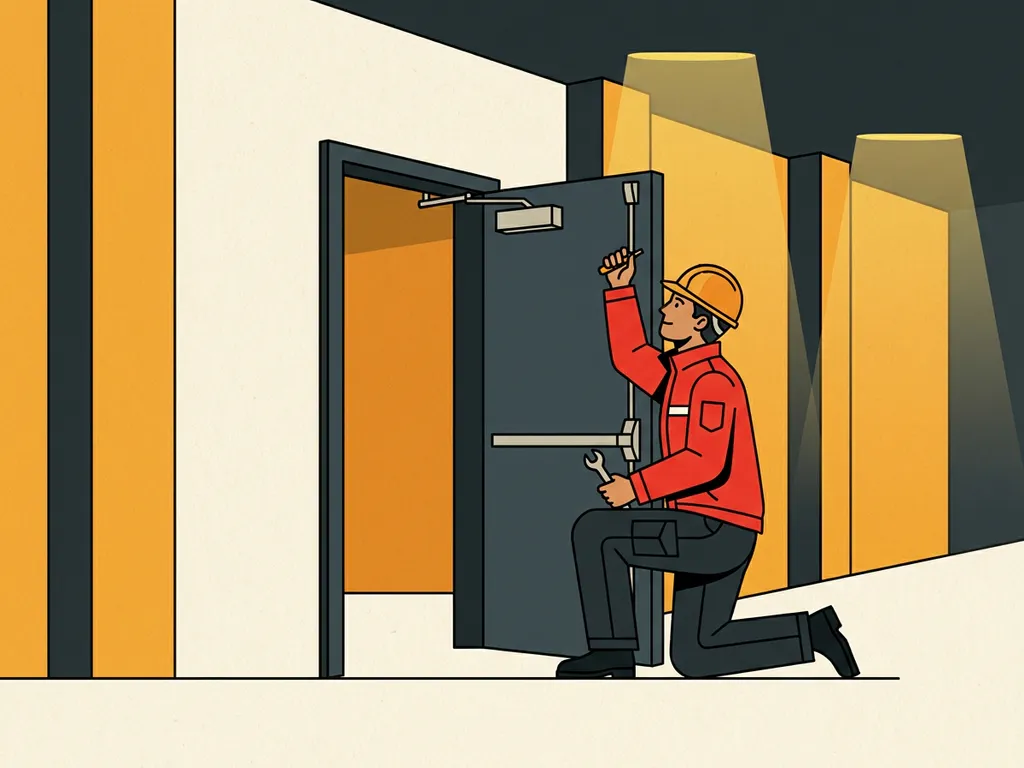
Automatic fire doors must be inspected and serviced at least once a year by a qualified technician, and in high-traffic or demanding industrial environments, twice-yearly inspections are common practice. The specific maintenance frequency depends on the door type, its operating intensity, and the requirements set by the manufacturer and applicable national regulations. This article unpacks exactly what those inspections involve, who is responsible, and what happens when maintenance is skipped.
How often do automatic fire doors need to be inspected?
Automatic fire doors require a minimum of one professional inspection per year. In industrial environments where doors operate frequently, such as production halls, logistics centres, or warehouses with forklift traffic, semi-annual inspections are strongly recommended. The manufacturer’s maintenance schedule always takes precedence, and any door that has been involved in a fire event or collision must be inspected immediately, regardless of the regular cycle.
The annual minimum is not arbitrary. Fire doors are life-safety components, and their reliability depends on mechanical parts, automatic closing mechanisms, and alarm integration all functioning in coordination. Over time, hinges wear, seals compress, and hold-open devices can drift out of calibration. An annual check catches these issues before they become compliance failures.
In the Netherlands, the BBL (Besluit Bouwwerken Leefomgeving) requires that fire-safety provisions in a building remain in working order. This means the maintenance obligation is not limited to the door itself but extends to the full system, including any smoke detection triggers or alarm interfaces that activate the door. The BBL sets the absolute minimum requirement; the actual maintenance obligations for a specific installation may be more demanding depending on the door type, its classification, and any sector-specific regulations or insurer requirements that apply. Facility managers and building owners should treat the inspection schedule as a legal minimum, not a best-case scenario.
What does a fire door maintenance check actually involve?
A fire door maintenance check covers the mechanical condition, operational performance, and system integration of the door. The technician verifies that the door closes fully and latches correctly, that the automatic release mechanism activates on cue, that seals and intumescent strips are undamaged, and that the door’s classification markings and certification labels are still legible and intact.
Mechanical and physical inspection
The technician checks hinges, tracks, rollers, and guides for wear or damage. For roller doors and overhead doors, the spring tension and drive mechanism are tested. Seals around the door perimeter, including intumescent strips that expand under heat to prevent smoke and flame passage, are inspected for compression, tears, or gaps. Any seal damage is a direct threat to the door’s classified fire resistance performance — as established by fire resistance testing per EN 1634-1 and classified under EN 13501-2 — and must be replaced before the door is signed off.
Operational and system testing
The automatic closing function is tested under simulated alarm conditions. For doors fitted with a magnetic hold-open device, the release response is timed and verified. Doors connected to a building fire alarm system are tested to confirm the signal path between the detection system and the door release mechanism is active and uninterrupted. Any door that fails to close fully and latch within the required time must be taken out of service or repaired before the building can be considered compliant.
The inspection concludes with a written report documenting all findings, any remedial work carried out, and the date of the next scheduled service. This report forms the core of the maintenance record that building owners and facility managers are obligated to keep.
Who is responsible for maintaining automatic fire doors?
The legal responsibility for maintaining automatic fire doors rests with the building owner or the party responsible for building management, which in practice is often the facility manager or property operator. This obligation cannot be transferred to a tenant unless explicitly stated in the lease agreement, and even then the owner retains ultimate liability for building code compliance.
For the maintenance work itself, a qualified and competent technician must carry out inspections and servicing. In the Netherlands, this means a technician with demonstrable knowledge of the door type, the relevant standards — including EN 1634-1 for fire resistance testing and EN 13501-2 for classification — and the fire alarm integration. Many manufacturers, including Metacon-Next, supply their products exclusively through certified dealers and installers who are trained to maintain the specific products they install. Using the installing dealer for ongoing maintenance is not only practical but also ensures the technician has product-specific knowledge.
Architects specifying automatic fire doors at the design stage should note that maintenance accessibility is a design consideration. A door that is difficult to reach for inspection or that lacks clear service access points creates a compliance risk over the building’s lifetime. Specifying products with clear maintenance documentation and a certified installer network reduces that risk significantly.
What happens if automatic fire door maintenance is neglected?
Neglecting automatic fire door maintenance creates three distinct categories of risk: legal liability, insurance consequences, and most critically, failure during a fire event. A door that has not been serviced may fail to close, fail to latch, or fail to release from its hold-open position when an alarm activates, directly compromising the fire compartmentation the door was installed to provide.
From a legal standpoint, a building owner who cannot demonstrate a maintained inspection record may be found in breach of the BBL’s requirement to keep fire-safety provisions operational. The BBL sets the absolute minimum; where sector-specific regulations such as PGS15 apply, or where an insurer imposes stricter requirements, the maintenance obligations may go further still. In the event of a fire, an inadequate maintenance record can shift liability significantly. Insurance policies for commercial and industrial properties routinely include clauses requiring that fire-safety systems, including fire doors, are maintained in accordance with manufacturer specifications and applicable regulations. A lapsed maintenance schedule can be grounds for a claim being reduced or denied.
The practical consequences extend beyond legal and financial exposure. A fire door that has not been inspected may appear functional in daily use but fail under the thermal and pressure conditions of an actual fire. Intumescent seals that have compressed without replacement, or a closing mechanism that is slightly out of adjustment, can cause the door to fall short of its rated fire resistance classification — whether that is an EW, EI1, or EI2 classification — at the moment it matters most. Maintenance is what keeps a certified product performing to its certification.
What documentation should be kept for fire door maintenance?
Every automatic fire door installation should have a maintenance logbook or digital record that captures the installation date, the product’s CE certification and classification report reference, each inspection date and the name of the technician, findings from each visit, any repairs or parts replaced, and the date of the next scheduled inspection. This documentation serves as proof of due diligence for regulators, insurers, and in the event of a fire investigation.
The product documentation provided at installation forms the baseline of this record. For fire-rated industrial doors from Metacon-Next, this includes the CE declaration of performance issued under EN 16034 (fire and smoke resisting closing elements) and EN 13241 (industrial doors generally) — both CE marking standards apply simultaneously to industrial fire doors — the Efectis classification report, and where applicable, the EPD. These documents should be stored alongside the maintenance log, not separately, so that any inspection or audit can link the product’s certified performance to its ongoing maintenance history in a single file.
Architects and specifiers who request this documentation at the tender stage, rather than after installation, are in a significantly stronger position. Knowing that a manufacturer publishes classification reports and EPDs openly, without requiring a formal request, removes a common source of delay and uncertainty during permitting and fire safety reviews. Metacon-Next makes its full technical documentation available through its product portal, which is accessible to architects and project teams at the specification stage.
For ongoing building management, the practical recommendation is to appoint a single point of responsibility for fire door maintenance records, whether that is the facility manager, a building management system, or the installing dealer operating under a service contract. Fragmented records across multiple parties are a common source of gaps that only become visible during an audit or an insurance claim. A consolidated, up-to-date maintenance file is the simplest way to demonstrate that a building’s fire compartmentation is being actively managed, not just installed and forgotten.
If you are specifying automatic fire doors for a new or renovated industrial building and need full technical documentation from day one, request a project quotation from Metacon-Next or contact the team directly to discuss your specification requirements.