

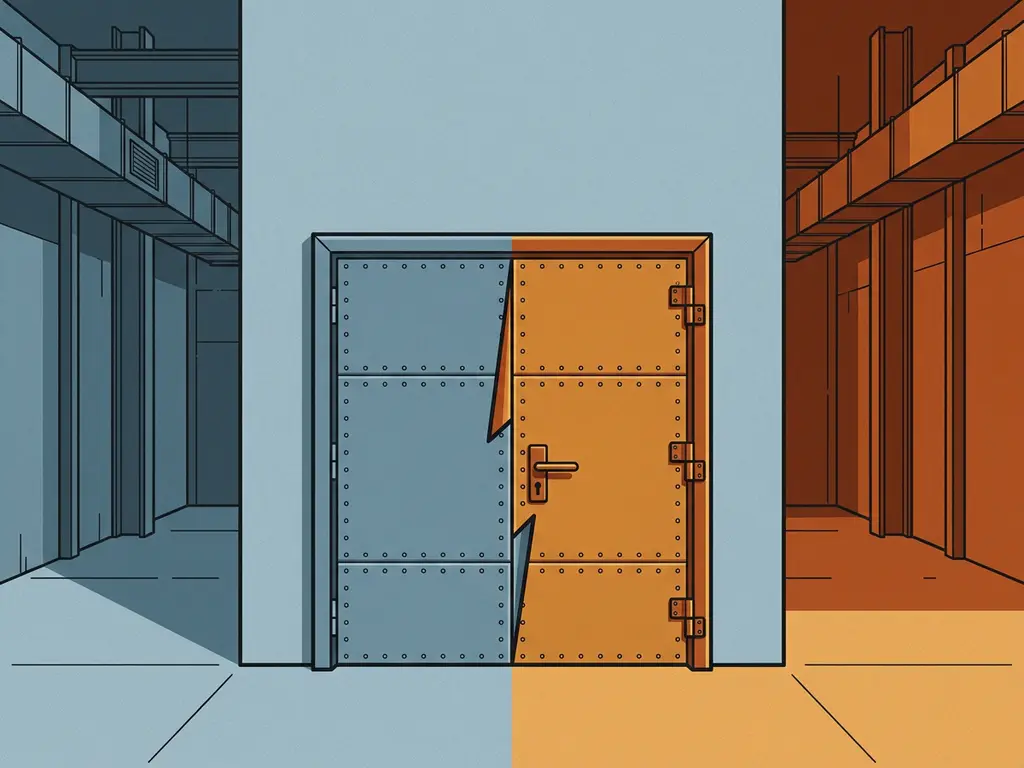
EI1 and EI2 are two variants of the insulation criterion applied to fire-rated doors. EI2 requires that the surface temperature on the unexposed face of the door does not exceed 180°C above ambient at any single point, and no more than 140°C on average. EI1 applies only the average limit, making it the less strict of the two. The distinction matters because building regulations and fire safety calculations specify which level of insulation is required for a given opening, and specifying the wrong one can invalidate a door’s compliance entirely. This article works through the key questions architects and specifiers encounter when distinguishing between EI1, EI2, and EW classifications.
What does the insulation criterion actually measure in a fire door?
The insulation criterion in a fire door classification measures how much heat is transmitted through the door to the unexposed side during a standardised fire test. It sets limits on surface temperature rise, ensuring that materials on the protected side of the door do not ignite and that people in the protected space are not exposed to radiant heat that causes harm before evacuation is complete.
Under EN 13501-2 — the classification standard for fire resistance of building elements, including doors — the insulation criterion is denoted by the letter I. It is always measured alongside the integrity criterion (E), which assesses whether flames or hot gases pass through gaps or cracks in the door. A door classified as EI1 or EI2 must satisfy both integrity and insulation simultaneously for the stated duration. A third criterion, W, addresses radiation reduction — limiting radiant heat transfer through the door — and represents the Dutch standard baseline classification. W is a distinct performance requirement, not a lesser version of insulation.
The temperature limits are defined in EN 1634-1, the test method standard for fire resistance of door assemblies. Two measurement points matter: the average temperature rise across the unexposed face, and the maximum temperature rise at any single point. These two thresholds are what separate EI1 from EI2 in practice.
What is the difference between EI1 and EI2?
EI1 and EI2 differ in how strictly the insulation criterion is applied at a single point on the unexposed face of the door. Both classifications require that the average surface temperature rise does not exceed 140°C above the initial temperature. EI2 adds a second condition: no individual measurement point may exceed 180°C above the initial temperature. EI1 has no such point limit, making it the less stringent of the two.
In practical terms, a door classified as EI1 may have localised hot spots on its unexposed face during a fire test, as long as the average temperature across the surface remains within limits. A door classified as EI2 must control heat transfer more uniformly across the entire surface, which typically requires more insulation material, a more complex door construction, or both.
For architects specifying fire doors, this distinction is not merely technical. A door supplied with an EI1 classification cannot be substituted for a position where EI2 is required, even if the fire resistance duration is identical. The classification codes are not interchangeable. When reviewing a manufacturer’s technical documentation, always confirm whether the tested and certified classification is EI1 or EI2 for the relevant product and configuration — never rely on documentation that states only “EI” without the suffix.
Metacon-Next publishes full classification reports for its fire-rated industrial door range, making it straightforward to confirm which insulation level applies to each product type and opening configuration before a specification is finalised.
When is EI2 required instead of EI1?
EI2 is required when the fire safety calculation for a specific project determines that the unexposed side of the door must be protected against localised heat transfer, not just average temperature rise. This is typically the case where people may be present in close proximity to the door on the protected side, where evacuation routes pass directly alongside the door, or where specific sector regulations impose stricter insulation requirements.
There is no universal rule that links a building type automatically to EI1 or EI2. The BBL (Besluit Bouwwerken Leefomgeving, formerly Bouwbesluit) sets only the absolute minimum requirement. Which classification actually applies to a given opening depends on the project-specific fire safety calculation, any applicable sector regulations such as PGS15 for chemical storage, insurer requirements, or a client’s own above-statutory requirements. A logistics warehouse and a healthcare complex may both require fire-rated doors, but the applicable insulation level is determined by the fire safety report for that specific project, not by a blanket classification based on building category alone.
When a fire safety engineer or building permit authority specifies EI2, that requirement must be met by the door product itself, including the frame and hardware as tested. It is not sufficient for a door to achieve EI2 performance in principle if the tested and certified assembly does not include the specific configuration being installed. This is why complete technical documentation — including the classification report and the CE declaration of performance — must be reviewed at specification stage rather than after an order is placed.
If you are uncertain which insulation level applies to a given opening, the correct approach is to consult the project’s fire safety calculation and, where necessary, the competent authority or a qualified fire safety engineer. Reaching out to a specialist early in the design process avoids costly corrections during permitting.
How does EI1 or EI2 affect door specification and documentation?
The EI1 or EI2 classification must be explicitly stated in the specification, because it determines which tested door assembly is compliant for a given opening. A specification that lists only “EI 60” without specifying EI1 or EI2 is incomplete and may result in a product being supplied that does not meet the intended performance level.
From a documentation perspective, the classification report produced after testing under EN 1634-1 will state whether the assembly achieved EI1 or EI2 for the tested duration. This report, along with the CE declaration of performance and the product’s extended application rules under EN 15269, defines the range of configurations and dimensions for which the classification is valid. Architects and specifiers should request these documents before finalising a product selection, not after. For industrial fire doors, CE marking is governed by two standards simultaneously: EN 16034, which covers fire- and smoke-resisting closing elements, and EN 13241, which applies to industrial doors generally. Both are mandatory and should be verified independently.
Environmental documentation is increasingly relevant alongside fire performance data. Environmental Product Declarations (EPDs) are now available for most Metacon-Next product lines, supporting BREEAM and LEED project requirements. An EPD is an information document, not an environmental label or award, but it provides the verified lifecycle data required for green building assessments.
Metacon-Next makes all certificates, classification reports, and EPDs publicly available, which means architects can confirm compliance without waiting for a supplier response. This level of transparency is not universal in the market, and it directly reduces the risk of documentation gaps emerging during a building permit review. Visit the Metacon-Next website to access product documentation for the full range.
What is the difference between EI and EW fire door classifications?
EI1, EI2, and EW are distinct fire resistance classifications under EN 13501-2, and they measure different things. An EI classification — always specified as either EI1 or EI2 — combines integrity and insulation: the door must limit both the passage of flames and hot gases and the transmission of heat through its surface, subject to the respective temperature thresholds. An EW classification combines integrity with a radiation reduction criterion, limiting the radiant heat flux transmitted through the door to a defined level, but without the surface temperature limits that EI1 or EI2 require.
In practical terms, an EW door permits more heat to pass through than an EI1 or EI2 door of the same duration. The radiation limit in EW is set at 15 kW/m², which is the threshold below which a person standing near the door would not sustain burns within a short period. This makes EW suitable for openings where the fire safety calculation confirms that the radiation level is acceptable for the specific scenario.
In the Netherlands, EW60 is the standard baseline classification for fire-resistant industrial doors — not a minimum in the sense of a fixed universal rule, but the typical default from which project-specific calculations may deviate upward. When reviewing Dutch building regulations or fire safety reports, it is important not to conflate the W criterion with EI, or to treat EW and EI as equivalent levels of protection with different names. They are structurally different performance requirements, and the applicable classification for any given opening is determined by the project’s fire safety calculation.
The choice between EW and EI1 or EI2 is determined by the fire safety calculation for the project, not by a general preference or assumption. An architect specifying a fire door for a corridor or escape route will typically encounter different requirements than one specifying a door for a compartment boundary in an open production hall. Whether a particular classification is sufficient for a specific application depends on that project’s compartmentalisation calculation — this is not something that can be answered with a general rule. Consult a qualified fire safety engineer or contact Metacon-Next directly if you need guidance on which classification applies to your situation. Metacon-Next’s product range covers EW, EI1, and EI2 classifications across multiple door types, enabling the correct solution to be selected based on the actual project requirement.
For projects where the classification requirement is clear and the opening dimensions are defined, requesting a quotation from Metacon-Next through the dealer network is a straightforward next step. All products are supplied and installed exclusively through certified dealers, ensuring that both the product and the installation meet the requirements documented in the specification. Learn more about the company and its manufacturing approach on the about us page.
Related Articles
- When must a fire door be fitted with an automatic closing mechanism?
- What fire door class is required for a forklift passage?
- Can building staff install fire doors without a certified installer?
- What gets checked during a fire safety inspection?
- Is it possible to combine high-speed doors with fire resistance?