

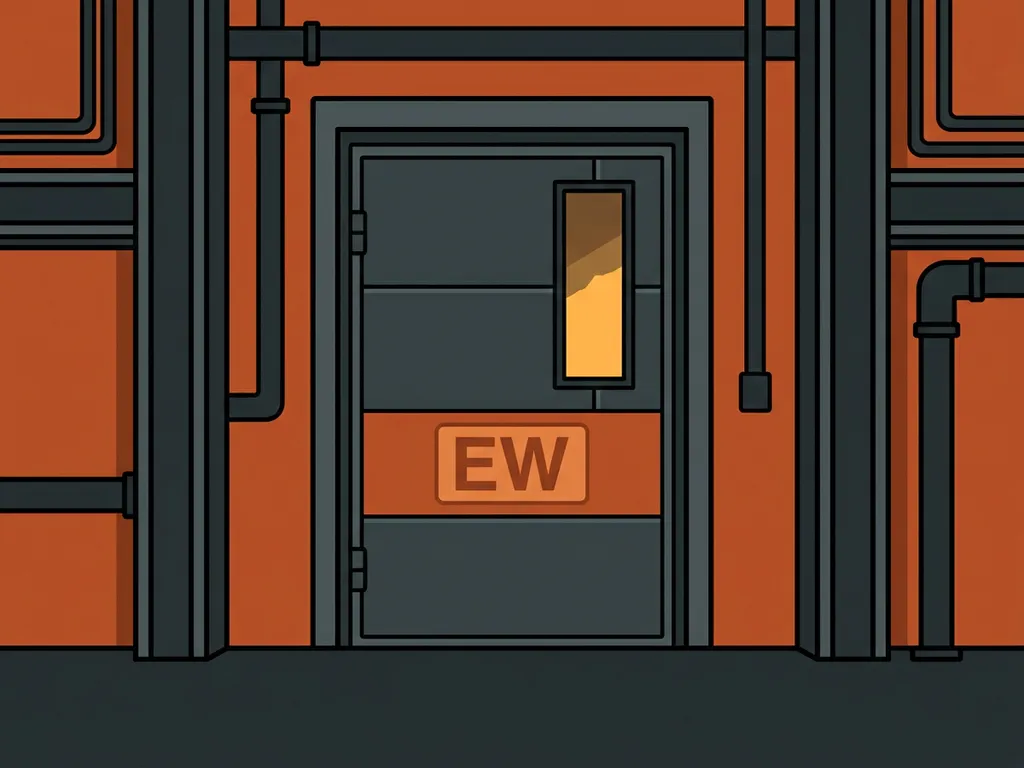
EW on a fire door classification means the door limits both flame spread and radiant heat transfer through the assembly for a defined period, but does not fully restrict heat transmission the way an EI1- or EI2-classified door does. EW is a recognised European fire resistance criterion under EN 13501-2, sitting between the basic integrity-only criterion (E) and the full insulation criterion (EI1 or EI2). In the Netherlands, EW60 is the standard baseline classification for industrial fire doors. Architects specifying fire-rated openings in industrial buildings will encounter EW most often when compartmentalisation is required but full thermal insulation is not mandated by the project-specific fire safety calculation. The sections below unpack how EW compares to EI1 and EI2, what the number means, when EW may be appropriate, and how it is tested.
How is EW different from EI on a fire door?
EW and EI both require a fire door to maintain integrity — meaning no flames or hot gases pass through the assembly — but they differ in how much heat the door is permitted to transmit. An EW door limits the radiation on the unexposed side to a maximum of 15 kW/m², which is enough to prevent immediate ignition of materials close to the door. This radiation-limiting criterion is the Dutch standard baseline for industrial fire doors. An EI-classified door goes further: it restricts the temperature rise on the unexposed face to a defined maximum above ambient.
The insulation criterion splits into two sub-classifications that must always be named explicitly: EI1 applies a stricter temperature-rise limit, while EI2 permits a higher temperature rise on the unexposed side. EW does not carry this sub-classification because it applies only the radiation limit, not the full temperature-rise limit.
In practical terms, a person can stand closer to the unexposed side of an EI1 or EI2 door without risk of radiant heat injury, whereas the space immediately behind an EW door may still become uncomfortably or dangerously warm over time. For architects, the distinction matters because specifying EW where EI1 or EI2 is required — or vice versa — is a design decision with regulatory and liability consequences. The correct classification is determined by the project-specific fire safety calculation, not by a blanket rule based on building type.
What does the number after EW mean?
The number after EW indicates the duration, in minutes, for which the door maintains its classified performance under standardised fire test conditions per EN 13501-2. EW 30 means the door holds its integrity and radiation-limiting performance for at least 30 minutes; EW 60 means 60 minutes, and so on. The number is not a safety margin — it is the minimum verified duration from testing under EN 1634-1.
These durations correspond to the time a fire door is expected to contain a fire long enough for evacuation, fire brigade intervention, or automatic suppression systems to take effect. The required duration for a specific opening is determined by the fire safety engineer based on compartment size, occupancy, travel distances, and any applicable sector regulations such as PGS15 for hazardous substances storage.
It is worth noting that a higher number does not automatically make a door better suited to every application. An EW 60 door addresses a different performance requirement than an EI1-60 or EI2-60 door, even though all three are classified for the same duration. Comparing them requires understanding which criterion — radiation limitation or full insulation — the project’s fire safety calculation demands.
When is an EW classification sufficient for an industrial opening?
An EW classification may be sufficient when the project-specific fire safety calculation confirms that limiting radiant heat flux to 15 kW/m² on the unexposed side is adequate to protect people and adjacent compartments, and full thermal insulation is not required. This situation arises most often in openings where the unexposed side is not a continuously occupied space, where travel distances allow people to move away from the door face, or where the fire safety strategy relies on other active measures.
In industrial settings — logistics centres, production halls, and warehouse environments — EW doors are sometimes specified for large openings where the thermal mass of a full EI1 or EI2 assembly would be impractical, or where forklift passage and high-throughput operations require a lighter or faster-operating door construction. However, this is always subject to the fire safety engineer’s sign-off. No manufacturer, including Metacon-Next, can determine whether EW is sufficient for a specific opening without knowing the project’s fire safety calculation.
It is equally important to understand what EW does not cover. If the fire safety calculation requires that the temperature on the unexposed side remain below a threshold that EW cannot guarantee, then EI1 or EI2 is the correct specification. The BBL (Besluit Bouwwerken Leefomgeving) sets the absolute minimum requirement only. Project deviations from standard building regulations, sector-specific regulations such as PGS15, client requirements, and insurer requirements can all push the required classification higher than the statutory minimum — and it is the specific cause of that deviation, not a general rule about building type, that determines which classification applies.
How is EW tested and certified under European standards?
EW fire doors are tested under EN 1634-1, the European standard for fire resistance and smoke control tests for door and shutter assemblies. During the test, the door assembly is exposed to a standardised temperature-time curve in a furnace. Integrity is assessed by monitoring for flame passage and hot gas leakage. The radiation criterion is measured using a radiometer positioned on the unexposed side at a defined distance from the door face, confirming that the heat flux does not exceed 15 kW/m².
Once tested, the results are classified per EN 13501-2 and documented in a classification report issued by an accredited testing body. For CE marking, two harmonised standards apply simultaneously to industrial fire doors: EN 16034 covers the fire- and smoke-resisting closing function, while EN 13241 applies to the door as an industrial product regardless of its fire rating. The door manufacturer must issue a Declaration of Performance (DoP) under the Construction Products Regulation (CPR) referencing both the test evidence and the applicable harmonised standards. Architects and specifiers should request both the classification report and the DoP at specification stage — not after the order is placed — to ensure the product is demonstrably compliant before it appears in a permit application.
Metacon-Next’s fire-rated industrial doors are tested by Efectis, an accredited European fire testing laboratory, and all classification reports are publicly available. This level of documentation transparency is not a regulatory requirement for manufacturers, but it is what architects working on permit-ready designs need to close a specification file with confidence.
Can an EW fire door also provide burglar resistance?
Yes, a fire door classified as EW can also be designed and tested to provide burglar resistance, provided the door construction satisfies both the fire resistance test requirements under EN 1634-1 and the burglar resistance test requirements under the applicable resistance class standard. These are separate performance criteria tested independently, and a door carrying both classifications must pass both test regimes without one compromising the other.
In industrial applications, combining fire resistance with burglar resistance in a single door assembly is increasingly common. A logistics facility or production hall may need an opening that both compartmentalises fire and resists forced entry during non-operational hours. Specifying a dual-classified door eliminates the need for a secondary security layer on the same opening, which simplifies the construction detail and reduces the number of components requiring maintenance.
The practical constraint is that not every EW door construction is compatible with burglar resistance testing. The door leaf thickness, frame anchoring, hardware, and locking mechanism all affect burglar resistance performance, and these elements interact with the fire-rated construction in ways that must be validated through testing. Architects should confirm with the manufacturer which specific product configurations carry both classifications, and request the relevant test evidence for each criterion separately.
Metacon-Next manufactures fire-rated and burglar-resistant industrial doors as part of its core product range, with in-house R&D ensuring that dual-classified configurations are developed and tested as complete systems rather than retrofitted combinations. If you are working on a project where both criteria apply to the same opening, the Metacon-Next team can provide the technical documentation needed to support your specification. For projects at an earlier stage, a quotation request gives you access to the product range and available classifications for your specific opening requirements. You can also learn more about the company’s approach to certified manufacturing on the about us page.
Related Articles
- What fire door class do I need for my project?
- Can building staff install fire doors without a certified installer?
- How do custom industrial door lead times compare to standard products?
- How do you specify a fire door in a tender for new construction?
- Is it possible to combine high-speed doors with fire resistance?