

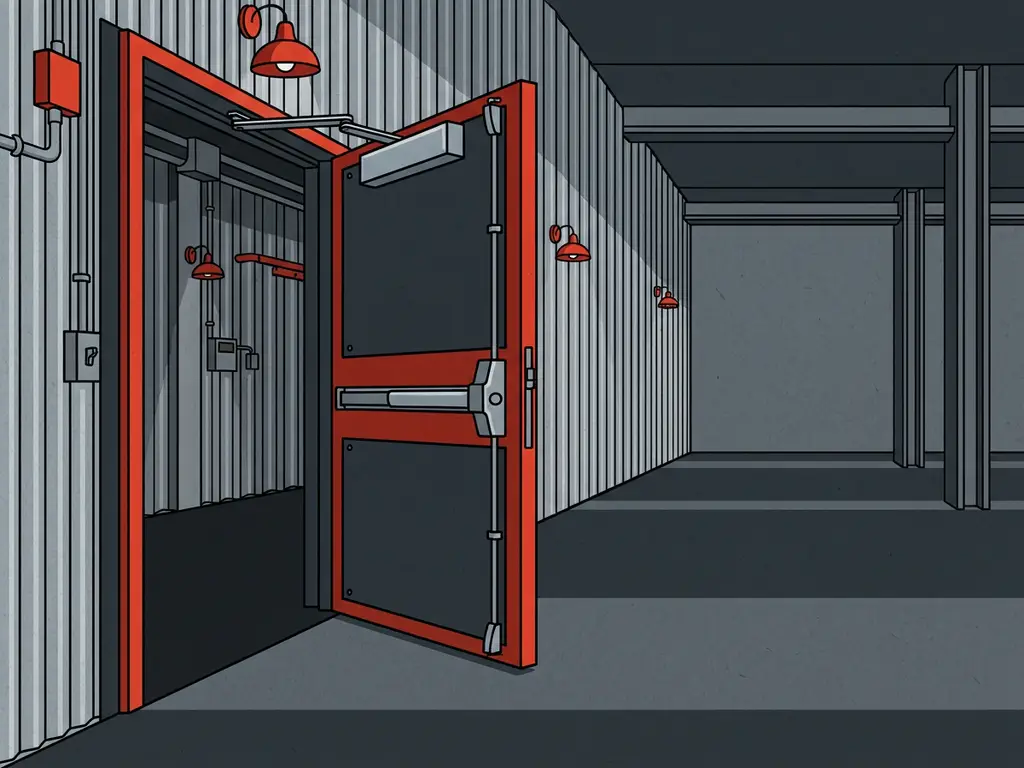
A fire door must be fitted with an automatic closing mechanism whenever it forms part of a fire-resistant compartment boundary and cannot be guaranteed to be closed at the moment a fire breaks out. In practice, this applies to most fire doors in industrial and commercial buildings — because a door left open, even briefly, eliminates the compartmentation it was specified to provide. The sections below explain exactly when automatic closing is legally required, which door types are always affected, and how this requirement shapes the specification process.
Which building regulations determine when automatic closing is required?
In the Netherlands, the primary regulatory framework is the Besluit Bouwwerken Leefomgeving (BBL), which sets the absolute minimum requirements for fire compartmentation in new and renovated buildings. The BBL does not prescribe a single blanket rule for every door, but it does require that fire-resistant compartment boundaries — including the openings in them — maintain their integrity under fire conditions. For a door in a compartment boundary to meet that requirement, it must be closed at the moment a fire occurs. Where normal use means the door is regularly left open, an automatic closing mechanism becomes a functional necessity, not an optional feature.
Beyond the BBL minimum, project-specific fire safety calculations prepared by a fire safety engineer may impose stricter requirements. Sector regulations such as PGS 15 for hazardous substances storage and insurer requirements for industrial properties can also demand automatic closing where the BBL alone would not. Architects specifying fire doors for industrial buildings should treat the BBL as the floor, not the ceiling, and verify whether project deviations, sector regulations, client requirements, or insurer requirements apply before finalising the specification.
European harmonised standards — in particular EN 1634-1 for fire resistance testing of door assemblies — define how a door must perform during a fire test, but they do not directly prescribe when automatic closing is required in a building. That determination remains a national regulatory and project-specific question. CE-certified fire doors from manufacturers such as Metacon-Next carry classification reports that confirm tested performance under EN 13501-2, but the decision to require automatic closing sits with the fire safety engineer and the applicable regulations for that specific project.
What types of fire doors must always have a self-closing device?
Fire doors in escape routes and stairwells must always be equipped with a self-closing device. These openings are critical to safe evacuation: a door left open in a stairwell can allow smoke and heat to spread rapidly through a building, compromising the escape route for everyone using it. For this reason, the requirement for self-closing in these locations is not discretionary.
Beyond escape routes, the following door types consistently require automatic closing in industrial and commercial buildings:
- Doors between fire compartments where the compartment boundary must remain intact during a fire, regardless of operational use
- Doors to technical rooms such as transformer stations, electrical switchgear rooms, or server rooms, where a fire could spread rapidly to adjacent spaces
- Doors in storage areas for hazardous materials, where sector regulations such as PGS 15 typically require automatic closure as part of the fire safety measures
- Fire doors in healthcare complexes and care facilities, where occupants may be unable to close doors themselves during an emergency
- Large industrial openings — roller doors, overhead doors, and sliding doors — used for internal transport in production halls and logistics centres, where the door is frequently open during working hours
For large industrial openings in particular, the automatic closing mechanism is not just a regulatory requirement but a practical necessity. A fire-rated roller door that closes automatically on an alarm signal provides compartmentation precisely when it is needed, without relying on human intervention. Metacon-Next’s fire-rated industrial doors — including roller doors and overhead doors — are designed with this operational reality in mind, integrating automatic closing as a standard feature for compartmentation applications.
What’s the difference between a self-closing and a hold-open device?
A self-closing device ensures that a fire door returns to the closed position automatically after each use. It is a mechanical or electromechanical component — typically a door closer — that applies constant closing force. The door closes every time it is opened, regardless of whether an alarm has been triggered. This is the baseline requirement for most fire doors in escape routes and compartment boundaries.
A hold-open device does the opposite: it keeps the door in the open position during normal use, then releases it to close automatically when a fire alarm is triggered. Hold-open devices are connected to the building’s fire detection system. When the alarm activates, the magnetic or electromechanical hold-open releases, and the door’s self-closing mechanism takes over to bring it to the closed position.
When is a hold-open device permitted?
Hold-open devices are permitted where keeping a fire door open during normal operations is functionally necessary — for example, in corridors with high pedestrian traffic or in production environments where doors are passed through continuously. The critical condition is that the hold-open device must be connected to an approved fire detection system and must release reliably on alarm. A door held open by a wedge, a chain, or any non-approved method does not meet the requirement and eliminates the door’s fire resistance classification in practice.
When must the door close on every use rather than only on alarm?
In escape routes, stairwells, and any location where the fire safety design depends on the door being closed between uses, a hold-open device is not appropriate. These doors must return to the closed position after every passage. A hold-open device in a stairwell, for instance, would mean the door is open whenever the alarm has not yet triggered — exactly the period during which an early fire could spread undetected. In these locations, only a self-closing device without hold-open functionality is compliant.
Does every fire classification require an automatic closing mechanism?
No — the fire resistance classification of a door (EW, EI1, EI2, and the duration in minutes, per EN 13501-2) does not by itself determine whether automatic closing is required. The closing requirement is determined by the door’s function in the building, its location relative to compartment boundaries and escape routes, and the applicable regulations for that project. A door classified EI1-60 in a low-traffic storage area may not require automatic closing, while a door with the same classification in an escape stairwell always will.
It is important not to conflate two separate questions: what fire resistance class does this opening need, and does the door in this opening need to close automatically? The first is answered by the fire safety calculation and the BBL minimum requirement. The second is answered by the function of that specific opening in the building’s fire safety strategy. Both questions must be answered independently during specification — and for project-specific guidance, a qualified fire safety engineer or Metacon-Next directly should be consulted.
That said, higher-classification doors — such as those rated EI1-90 or EI2-60 — are typically specified for openings in boundaries where compartmentation is critical. In practice, these openings almost always require automatic closing, because the investment in a high fire resistance rating is only meaningful if the door is actually closed when a fire occurs. The classification and the closing requirement tend to align, but the closing requirement must be derived from the regulations and the fire safety design, not assumed from the classification alone.
How does an automatic closing mechanism affect door specification?
Specifying automatic closing adds several technical and coordination requirements to the door specification. The closing mechanism must be compatible with the door type, the opening size, and the operational environment. For industrial doors — roller doors, overhead doors, large sliding doors — the mechanism must be capable of reliably closing a heavy door assembly, which places demands on the actuator, the power supply, and fail-safe behaviour in a power outage.
Key specification considerations include:
- Integration with the fire detection system: If a hold-open device is used, the release mechanism must be connected to the building’s fire alarm system. This requires coordination between the door specification and the building services design at an early stage.
- Fail-safe closing: In the event of a power failure, the door must close — not remain open. This is a fundamental safety requirement and must be confirmed in the product documentation.
- Closing speed and force: The door must close completely and latch within the time and force parameters defined in the relevant standards. For large industrial openings, this is a non-trivial engineering requirement.
- Maintenance obligations: Automatic closing mechanisms require periodic inspection and maintenance to remain functional. The specification should define maintenance intervals and responsibilities, and the installer must provide documentation confirming the mechanism was correctly commissioned.
- Impact on CE classification: The automatic closing mechanism is part of the tested door assembly. Two CE-marking standards apply simultaneously to industrial fire doors: EN 16034 (fire and smoke resisting closing element) and EN 13241 (industrial door, general). Substituting a different closer or actuator after installation can invalidate the CE classification under both standards. Architects should confirm that the specified mechanism matches what was present during the fire resistance test.
For architects specifying fire-rated industrial doors, complete technical documentation is essential at this stage. Classification reports issued under EN 13501-2 must confirm that the tested assembly included the closing mechanism specified for the project. Fire-rated industrial doors that carry full classification reports and EPDs — available publicly rather than on request — allow architects to verify these details without delays in the specification process.
If you are working on a project where automatic closing requirements are still being determined, contact Metacon-Next for technical support, or request a quotation with your project parameters so the right product and closing configuration can be identified from the outset. Metacon-Next’s in-house R&D team and certified dealer network ensure that the specified door, its closing mechanism, and its installation are all covered by the same quality framework — giving architects the documentation they need to close a design file with confidence.