

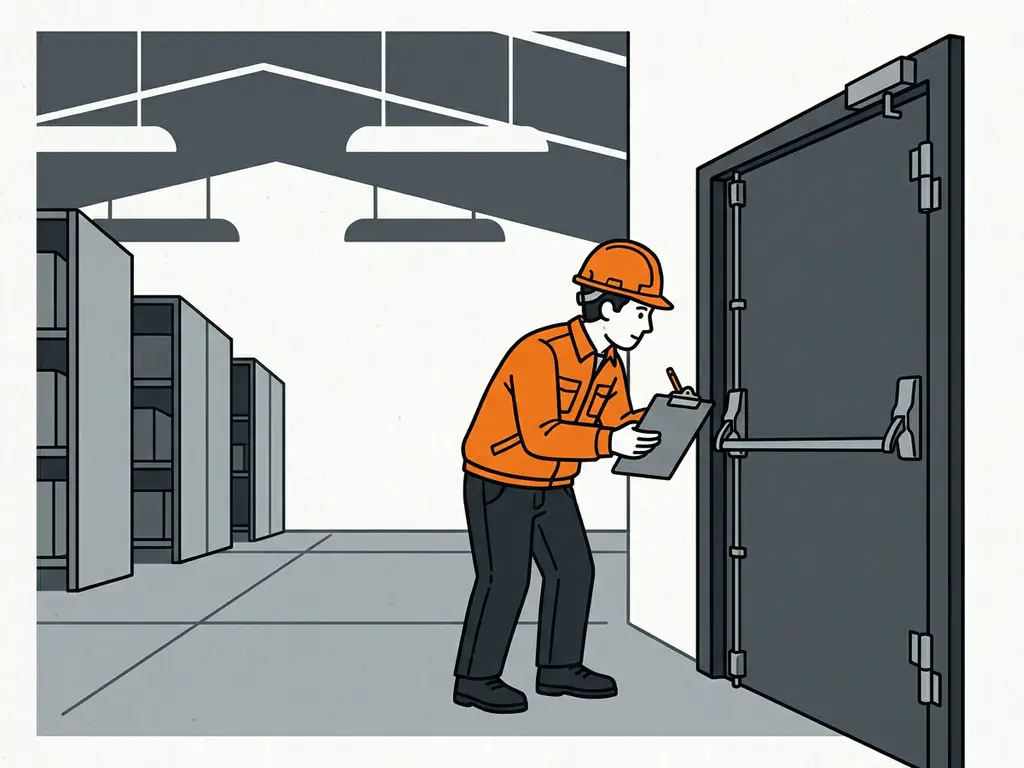
Insurers assess fire door compliance in industrial buildings by reviewing whether installed doors carry the correct fire resistance classification for their location, whether they are CE-certified and independently tested, and whether the installation meets the requirements of the applicable certification. A door that looks like the right product on paper but lacks complete documentation or was installed incorrectly can still be treated as non-compliant. The sections below address the specific questions insurers ask and what facility managers, architects, and contractors need to prepare.
What documentation do insurers request when assessing fire doors?
Insurers typically request the CE declaration of performance, the classification report from an accredited test body, and evidence that the installed door matches the tested configuration. For industrial buildings, they may also ask for the installation record, maintenance logs, and any environmental product declarations that are part of the building’s compliance file. Incomplete documentation is one of the most common reasons an insurer flags a non-conformity.
The classification report is particularly important because it defines the exact conditions under which the door achieved its fire resistance rating. Fire resistance is classified per EN 13501-2 and describes how long a closed door holds back fire — expressed as a combination of performance criteria (E, W, I1, or I2) and a duration in minutes. If the installed door deviates from the tested configuration in terms of dimensions, glazing, hardware, or wall construction, the classification no longer automatically applies. Insurers who understand passive fire protection will check for these deviations.
For buildings subject to sector-specific regulation — such as facilities storing hazardous substances under PGS15 — insurers may also request proof that the fire resistance class meets the requirements stated in the relevant sector document, not just the absolute minimum set by the BBL (Besluit Bouwwerken Leefomgeving). Having all documentation available in a single, organised file significantly shortens the assessment process. Manufacturers like Metacon-Next publish classification reports, CE declarations, and EPDs directly on their website, which means specifiers and facility managers can retrieve the full documentation set without waiting for a supplier response.
How do insurers define ‘compliant’ for industrial fire doors?
For insurers, a fire door is compliant when it carries the correct classification for its location, was installed in accordance with the manufacturer’s certified installation instructions, and is maintained in a condition that preserves its tested performance. Compliance is not a single document check — it is the combination of the right product, correctly installed, and demonstrably maintained.
This definition has practical consequences. A door with a valid CE declaration that was installed by an uncertified party, or one that has been modified after installation, may not be considered compliant even if the product itself is fully certified. Insurers increasingly treat installation quality and maintenance history as part of the compliance picture, not as separate operational matters.
It is also worth noting that insurers may apply requirements that go beyond the statutory minimum. The BBL sets the absolute floor for fire resistance classification, but insurers can and do require higher classifications or additional performance criteria based on their own risk assessment of the building and its use. This is particularly common in logistics, chemical storage, and high-value manufacturing environments. Additional reasons a heavier classification may be required include sector-specific regulation such as PGS15, a client’s above-statutory requirements, or an insurer’s own risk-based criteria.
What fire resistance classifications do insurers typically expect?
There is no single classification that insurers universally require. The expected classification depends on the building type, the compartment function, the occupancy, and the insurer’s own risk model. In Dutch industrial buildings, the Dutch standard baseline is EW60 — meaning the door blocks flames and limits radiant heat transfer for 60 minutes — but this is a typical default, not a fixed universal requirement. The BBL establishes a statutory minimum, and insurers may require a heavier classification based on their own risk assessment, particularly when the building contains high-value assets or presents elevated risk.
The distinction between EW, EI1, and EI2 matters here. EW limits radiant heat transfer through the door — this is the Dutch standard baseline criterion. EI1 and EI2 both limit the temperature rise on the unexposed side of the door: EI1 applies the stricter criterion (a lower permitted temperature rise), while EI2 permits a higher temperature rise on the unexposed side. Insurers assessing industrial applications will often specify which criterion they require, and substituting one classification for another without explicit agreement can create gaps in coverage. Which classification is actually required for a specific location depends on the project-specific fire safety calculation — consult a qualified fire safety engineer or Metacon-Next directly for guidance on your situation.
For facilities subject to specific sector regulation, the required classification may be defined by that regulation rather than by the insurer directly. In those cases, the insurer will verify that the installed doors meet the sector requirement, and any shortfall will be treated as a compliance failure regardless of what the BBL permits. Reviewing the available fire resistance classes against both the statutory minimum and the insurer’s stated requirements before specification avoids this problem.
Can a non-certified fire door void industrial insurance coverage?
Yes. A fire door that lacks CE certification, was not tested by an accredited body, or cannot be shown to meet the classification stated in the building’s fire safety documentation can give an insurer grounds to reduce or deny a claim. The reasoning is straightforward: the building was assessed and insured on the assumption that passive fire protection met a defined standard. If it does not, the risk profile the insurer priced is inaccurate.
This is not a theoretical risk. In practice, insurers conducting post-loss investigations examine the installed fire doors as part of their assessment of whether the building met its stated fire safety requirements. A door that was installed as a cost-saving measure without proper certification can become the central issue in a claim dispute, even if it was not the direct cause of the fire damage.
The same principle applies to doors that were certified at the time of installation but were subsequently modified — for example, by cutting a service penetration through the door leaf, replacing hardware with non-approved components, or removing intumescent seals during maintenance. Any modification that is not covered by the original classification report creates a compliance gap that an insurer can use to challenge a claim.
How does installation quality affect insurer assessments?
Installation quality directly affects whether a certified fire door performs as tested. A door installed with incorrect frame fixings, inadequate intumescent sealing at the perimeter, or hardware that does not match the tested specification will not achieve its rated fire resistance in a real fire — and insurers who understand this will treat poor installation as a compliance failure equivalent to using a non-certified product.
Insurers increasingly ask for evidence that installation was carried out by a certified installer working to the manufacturer’s documented installation instructions. This is particularly relevant for industrial doors, where large opening dimensions, high-traffic environments, and integration with building management systems all create installation variables that are not present in standard residential or commercial applications.
Metacon-Next supplies its fire-rated industrial doors exclusively through certified dealers and installers within its international dealer network. This structure ensures that both the product and the installation are covered, which is exactly the evidence trail an insurer needs to confirm compliance. When a facility manager can provide the installer’s certification alongside the product documentation, the insurer’s assessment becomes straightforward rather than contested.
What should facility managers prepare before an insurer site visit?
Before an insurer site visit, facility managers should compile a complete compliance file for every fire door in the building. This file should include the CE declaration of performance, the classification report, the installation record confirming the installer’s certification, and the maintenance log showing regular inspection and servicing. If the building has undergone renovation or a change of use, any updated fire safety calculations should also be included.
A practical preparation checklist includes:
- CE declarations of performance for each fire door model installed
- Classification reports confirming the fire resistance class (per EN 13501-2) and tested configuration
- Installer certification or dealer credentials for the party that carried out the installation
- Maintenance logs covering at least the previous two inspection cycles
- Any EPDs required by the building’s environmental compliance documentation
- The fire safety calculation or compartmentation plan showing where each classification applies
Beyond documentation, facility managers should physically inspect each fire door before the visit. Check that intumescent seals are intact, that automatic closing mechanisms function correctly, that hold-open devices release properly on alarm, and that no unauthorised modifications have been made to the door leaf, frame, or hardware. Deficiencies found during a self-audit are far easier to address before an insurer visit than after one.
If there is any uncertainty about whether installed doors meet the required classification for their location, the most efficient step is to contact the manufacturer or dealer directly. Reaching out to Metacon-Next gives facility managers access to the full documentation set for installed products and the technical support needed to confirm that the classification matches the project-specific fire safety requirements — which depend on a fire safety calculation specific to the building, not on a general rule. For buildings currently under specification or renovation, requesting a quotation early in the process ensures that classification, documentation, and installation are aligned before the insurer ever visits the site. More information about the company’s approach to certification and compliance is available on the Metacon-Next about page.