

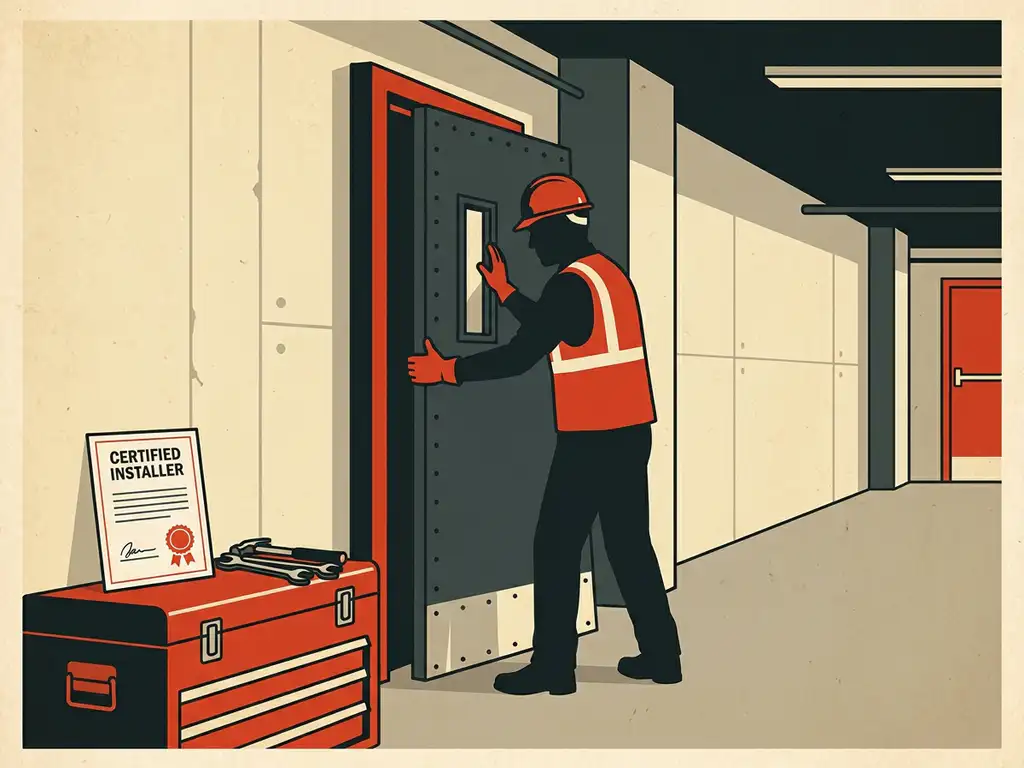
There is no single universal certification that legally qualifies someone to install a fire-rated door across all countries or jurisdictions. In the Netherlands, the requirement is that installation is carried out by a certified party within a recognised quality system — most commonly a company certified under the BRL 3232 scheme or an equivalent industry-recognised qualification. The sections below unpack what that certification covers, how it relates to the fire resistance classification of the door, and what documentation both installers and architects need to manage after installation.
Who is legally allowed to install a fire-rated door?
In the Netherlands, fire-rated doors must be installed by a company that holds a valid certification under a recognised quality scheme for the installation of fire-resistant building elements. The most relevant scheme is BRL 3232, which covers the installation of fire-resistant and smoke-control doors and shutters. Only companies certified under this or an equivalent recognised scheme are legally authorised to carry out this work on projects where compliance with the BBL (Besluit Bouwwerken Leefomgeving, formerly Bouwbesluit) must be demonstrated.
This requirement exists because a fire door is only as effective as its installation. A certified product fitted incorrectly — with the wrong frame anchoring, missing intumescent seals, or an improperly adjusted door closer — can fail to perform to its tested classification during a fire event. The certification of the installer is therefore not a formality but a structural part of the compliance chain.
For architects specifying fire-rated doors on industrial projects, this has a direct practical implication: the installer must be named or qualified at the point of specification, not sourced ad hoc after the product has been ordered. Metacon-Next supplies its fire-rated industrial doors exclusively through a network of certified dealers and installers, which means the installation qualification is built into the supply chain rather than left to chance.
What does a fire door installer certification actually cover?
A fire door installer certification covers the competence of a company to correctly fit fire-resistant door assemblies in accordance with the manufacturer’s installation instructions, the product’s classification report, and the applicable building standards. It is not a general construction licence — it is a product-category-specific qualification that demonstrates the installer understands how the certified performance of a fire door depends on correct installation.
In practice, certification under a scheme such as BRL 3232 requires the installing company to demonstrate that its personnel are trained, that its processes are documented, and that its work is subject to third-party auditing. The certification covers:
- Correct interpretation of the manufacturer’s installation instructions and classification report
- Proper preparation and assessment of the wall opening and surrounding construction
- Installation of the frame, door leaf, hardware, seals, and closing mechanisms in accordance with tested configurations
- Completion of a handover record confirming the installation matches the certified specification
What the certification does not cover is the design decision itself. The installer is responsible for fitting the product correctly — not for determining whether EI1-60, EI2-60, or EW60 is the appropriate classification for a given opening. That responsibility sits with the architect and the fire safety engineer, based on a project-specific fire safety calculation. The classification codes used here follow EN 13501-2, which classifies fire resistance performance: E (integrity — flames and hot gases are stopped), W (radiation reduction — limits radiant heat transfer, which is the Dutch standard baseline criterion), I1 (insulation, stricter criterion) and I2 (insulation, less strict criterion), followed by the number of minutes of guaranteed performance.
Does the installer certification depend on the fire resistance classification?
The certification scheme itself does not typically vary by fire resistance classification — a company certified under BRL 3232 is qualified to install doors across the classification range that scheme covers. However, the complexity of the installation does increase with higher classifications and more demanding product types, and not all certified installers will have practical experience across every product category.
For standard classifications such as EI1-60 or EI2-60, the pool of certified installers is relatively broad. For higher classifications, atypical opening dimensions, or specialist product types such as fire-rated roller doors, fire curtains, or sliding fire doors, the relevant experience of the installing company becomes a more important selection criterion. An architect specifying a fire-rated industrial door for a logistics centre or production hall should confirm not only that the installer holds the required certification but also that they have demonstrable experience with the specific product type and opening configuration.
Whether a particular fire resistance classification is sufficient for a specific application depends on the project’s fire safety calculation — not on the door alone. The BBL sets only the absolute minimum requirement; a heavier classification than the baseline may be required depending on the specific situation, for example where a project deviates from standard building regulations, where sector-specific regulation such as PGS15 applies (for chemical storage), or where a client or insurer sets a stricter above-statutory requirement. For any question about which classification applies to a specific project, consult a qualified fire safety engineer or contact Metacon-Next directly.
This is one reason why working with a manufacturer that operates through a structured dealer and installer network adds practical value at specification stage. The network qualification provides a baseline assurance that the installer is familiar with the product range, the installation procedures, and the documentation requirements.
What documentation must an installer provide after fitting a fire door?
After installing a fire-rated door, the installer must provide documentation that allows the building owner, facility manager, and inspecting authority to verify that the installation matches the certified specification. At minimum, this includes a completion or handover record confirming that the door was installed in accordance with the manufacturer’s installation instructions and the applicable classification report.
In practice, a complete installation file for a fire-rated door should contain:
- The CE declaration of performance for the door assembly
- The classification report from the testing body (in the Netherlands, commonly Efectis)
- The manufacturer’s installation instructions, specific to the product and configuration installed
- A completed installation checklist or handover document signed by the installer
- Details of any deviations from the standard configuration, with written confirmation from the manufacturer that the deviation is within the tested scope
For industrial fire doors, it is worth noting that two CE-relevant standards apply simultaneously: EN 16034 (covering the fire- and smoke-resistant closing function) and EN 13241 (covering the general requirements for industrial doors). Both are relevant to the CE declaration of performance and should be reflected in the documentation file. Fire resistance classification results are established through testing per EN 1634-1 and classified per EN 13501-2; smoke control results follow EN 1634-3, also classified per EN 13501-2.
For architects, this documentation is not optional — it forms part of the as-built record and may be required during a building inspection or fire safety review. Specifying a manufacturer that makes its classification reports and technical documentation publicly available from the outset simplifies this process considerably. Metacon-Next publishes its certificates, classification reports, and EPDs openly, so the documentation chain does not depend on a post-order request to the supplier.
How can an architect verify that a fire door was installed correctly?
An architect can verify the correct installation of a fire door by reviewing the completed installation documentation against the product’s classification report and the manufacturer’s installation instructions. This means checking that the frame type, wall construction, hardware, seals, and closing mechanism used on site correspond exactly to the tested configuration described in the classification report — not a similar configuration, but the specific one.
Beyond document review, there are practical on-site checks that an architect or appointed inspector can perform:
- Confirm the door leaf and frame markings match the product described in the CE declaration
- Check that intumescent seals are present, correctly positioned, and undamaged
- Verify that the door closer operates correctly and that the door returns to the fully closed and latched position without manual assistance
- Confirm that any hold-open or automatic release mechanisms are connected and functional
- Review the installer’s signed handover record for completeness
If discrepancies exist between the installed configuration and the classification report, the fire resistance of the assembly cannot be assumed to match the specified classification. In that case, the architect should request written confirmation from the manufacturer that the as-installed configuration remains within the tested scope, or require the installation to be corrected before sign-off.
For projects where documentation integrity is a priority from the start, working with a manufacturer whose products come with complete technical files and whose installers operate within a certified dealer network reduces the risk of these discrepancies arising. If you are specifying fire-rated doors for an industrial project and want to review the available product range and documentation, or discuss a specific project requirement, you can contact Metacon-Next directly or request a quotation through the website.
Related Articles
- How do fire resistance classes EI30, EI60 and EI90 differ?
- When is an EW fire door sufficient and when is EI required?
- Can an electric fire door meet EI fire resistance requirements?
- How do you determine the right fire resistance class for your project?
- What is the difference between a high-speed door and a fire door?