

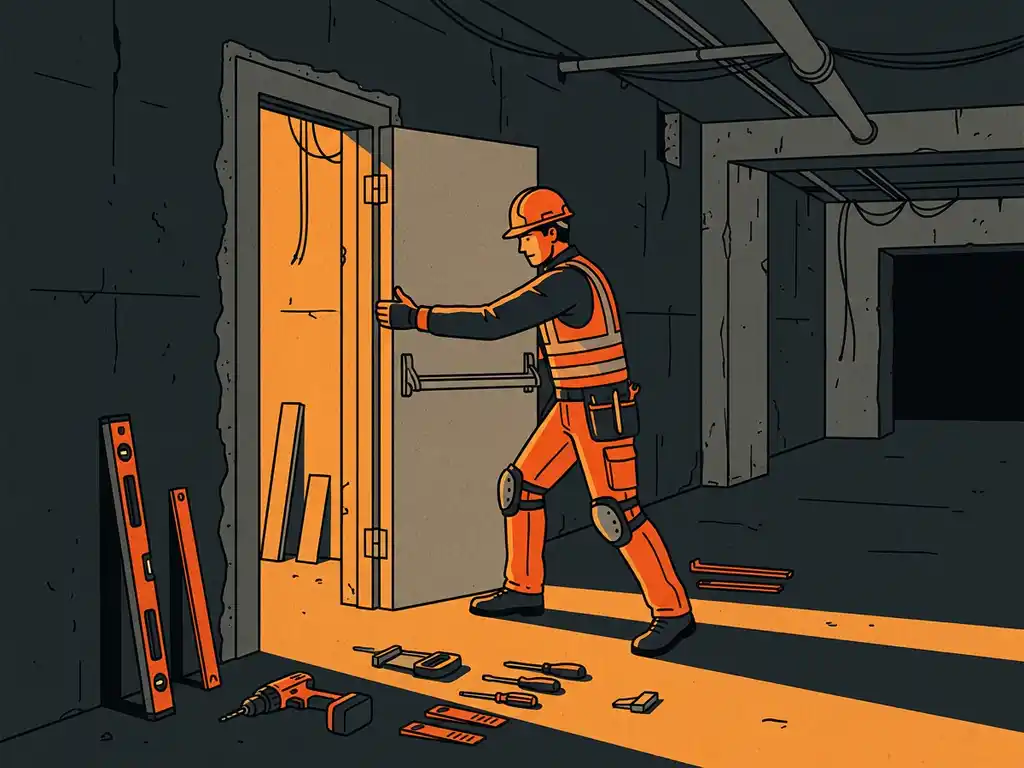
In most countries, building staff are not permitted to install fire doors without involving a certified or qualified installer. A fire door is a life-safety component, and its performance depends entirely on correct installation. If the installation does not follow the manufacturer’s instructions and applicable building regulations, the fire resistance classification is void — regardless of how well the door itself was manufactured.
This distinction matters for every project professional who signs off on a completed installation. The questions below unpack who carries legal responsibility, what qualifications actually mean in practice, and when specialist installation is non-negotiable.
Who is legally responsible for a correctly installed fire door?
Legal responsibility for a correctly installed fire door rests with the party who commissions and accepts the installation — typically the main contractor or the building owner, depending on the contract structure. In practice, this means someone with a professional role in the project must verify that the installation was carried out in accordance with the manufacturer’s installation instructions and the applicable national building regulations before the door is put into service.
In the Netherlands, the Besluit Bouwwerken Leefomgeving (BBL) sets the regulatory framework for fire safety in buildings, establishing the absolute minimum requirements. When a fire-rated door is installed as part of a fire compartment boundary, it must perform to its stated classification. The specific classification required depends on the project’s fire safety calculation — factors such as the building type, compartmentalisation design, any applicable sector-specific regulations (for example, PGS15 for chemical storage), client requirements, or insurer requirements may all point toward a classification heavier than the BBL minimum. If an installation is found to be non-compliant during a building inspection or, worse, during an actual fire event, liability falls on whoever accepted that installation as complete and adequate.
For architects specifying fire doors, this has a direct implication: the installation phase is not outside your sphere of influence. If you have specified a product for a particular classification and the installation does not honour that specification, the design intent fails. That is why specifying a fire-rated industrial door from a manufacturer that supplies through a controlled dealer and installer network is a meaningful risk-reduction measure, not a procurement detail.
What qualifications does a fire door installer actually need?
There is no single universal certification that applies to fire door installers across all countries, but the underlying requirement is consistent: the installer must be demonstrably competent to install the specific product according to the manufacturer’s instructions and the applicable standards. In practice, this means familiarity with EN 1634-1 fire resistance test conditions, understanding of how installation deviations affect classification, and the ability to read and follow detailed technical installation manuals.
In several European countries, industry bodies and certification schemes exist that formally qualify fire door installers. In the Netherlands, installers working on certified fire-resistant constructions are expected to work within the scope of the product’s classification report and CE declaration. Fire resistance classifications are determined per EN 13501-2 — producing codes such as EW60, EI1-60, or EI2-120 — and the installation must remain within the conditions under which those classifications were tested and awarded. A dealer or installer who is part of the manufacturer’s authorised network has typically been trained on the specific product family, which is a meaningful distinction from a general construction contractor who has never installed that product type before.
Metacon-Next supplies its fire-rated industrial doors exclusively through a network of certified dealers and installers. This structure exists precisely because product performance and installation quality are inseparable. An authorised installer has product-specific training, access to the correct technical documentation, and accountability within the dealer relationship.
What happens to the fire resistance classification if installation is incorrect?
If a fire door is installed incorrectly, the fire resistance classification is effectively invalidated. The classification — whether EI1-60, EI2-90, or EW60 — was awarded to the door as a system: door leaf, frame, hardware, seals, and installation conditions together. Change any element of that system outside the tested scope, and the tested performance can no longer be assumed to apply.
To understand what is at stake, it helps to be clear about what these classifications mean. Under EN 13501-2:
- E (integrity) means flames and hot gases do not pass through the closed door.
- W (radiation reduction) means radiant heat transfer through the door is limited — this is the Dutch standard baseline criterion. An EW60 door therefore blocks flames, hot gases, and limits radiant heat for 60 minutes.
- EI1 (insulation, stricter criterion) means the temperature rise on the unexposed side is limited to a lower threshold.
- EI2 (insulation, less strict criterion) means a higher temperature rise on the unexposed side is permitted, though still within a defined limit. An EI2-120 door blocks flames and limits temperature rise on the unexposed side (less strict criterion) for 120 minutes.
Whether a specific classification is sufficient for a given application depends on the project’s fire safety calculation — not on the door alone. A qualified fire safety engineer or the local authority is the right party to determine this.
Common installation errors that compromise classification include:
- Incorrect frame anchoring or insufficient fixing points in the surrounding construction
- Missing or incorrectly fitted intumescent seals around the frame perimeter
- Wrong gap tolerances between door leaf and frame
- Hardware fitted outside the tested configuration — for example, hinges not listed in the classification report
- Self-closing mechanisms that are incorrectly adjusted or omitted
Each of these errors can cause a door to fail to hold a fire compartment boundary during an actual fire event, even if the door leaf itself is fully certified. From a specification standpoint, this means a fire door is only as good as its installation. For architects and project managers, this reinforces why installation must be treated as part of the product specification, not an afterthought.
Does the manufacturer’s installation manual override general building staff judgment?
Yes. The manufacturer’s installation manual is not advisory guidance — it is part of the technical scope within which the product’s fire resistance classification was tested and awarded. Deviating from the installation manual without documented justification means the installation falls outside the tested scope, and the CE declaration and classification report no longer apply as written.
Building staff who are experienced with general door installation may feel confident making judgment calls: adjusting fixing positions, substituting a similar seal, or omitting a step that seems redundant. With standard doors, such adaptations may be harmless. With fire-rated doors, they are not. The classification report specifies exact conditions — materials, dimensions, fixings, hardware configurations — because those conditions were what was present during the fire resistance test conducted per EN 1634-1.
Manufacturers that provide thorough, product-specific installation documentation make this requirement easier to meet. Metacon-Next publishes detailed installation manuals per product, and its product range is designed so that installation follows a consistent logic across different door types. That consistency reduces the risk of interpretation errors during installation — but it does not replace the need for a qualified installer who understands what they are installing and why each step matters.
When should a project always use a specialist fire door installer?
A specialist fire door installer should always be used when the installed door forms part of a fire compartment boundary that is required by the building permit, when the opening involves non-standard dimensions or construction conditions, or when the project involves a building type subject to sector-specific fire safety regulation, such as a logistics warehouse, production facility, or healthcare complex.
More specifically, the following situations make specialist installation essential rather than optional:
- Large industrial openings: Oversized doors for forklift passages or goods transport require precise frame installation in heavy construction. Errors in frame alignment or anchoring have a disproportionate effect on door performance.
- Automatic fire doors with hold-open or release mechanisms: Doors connected to fire alarm systems or fitted with electromagnetic hold-open devices require both mechanical installation and electrical integration. Both must be within the tested scope.
- Projects subject to third-party inspection: When a building will undergo a formal fire safety inspection or when an insurer requires documented compliance, the installation must be traceable to a qualified party.
- Renovation of existing buildings: Existing construction conditions — irregular openings, mixed materials, older wall constructions — require experienced assessment to determine whether the tested installation scope can be met.
- Multi-product projects: When several fire door types are specified across one project, using an installer familiar with the full product range reduces coordination risk and ensures consistent installation standards throughout.
If you are specifying fire-rated industrial doors for a project that falls into any of these categories, working with a manufacturer that controls its installation channel is the most reliable way to ensure that the product performs as specified. Whether a particular classification such as EW60 or EI2-120 is the right choice for your specific compartmentalisation requirement is a question best answered by a qualified fire safety engineer or by contacting Metacon-Next directly. You can explore the full product range or contact Metacon-Next directly to discuss project-specific requirements and be connected with a qualified installer in your region.
For architects and specifiers who want to close a design file with confidence, the combination of CE-certified products, complete technical documentation, and installation through an authorised dealer network is the standard that protects both the building and the professional who specified it. You can request a quotation or learn more about Metacon-Next and how its dealer network operates across international markets.
Locations where changes were made:
No instances of “EN 13241-1”, “EN13241-1”, or “NEN-EN 13241-1” were found in the article. The standard is not mentioned anywhere in the source text, so no replacements were made.