

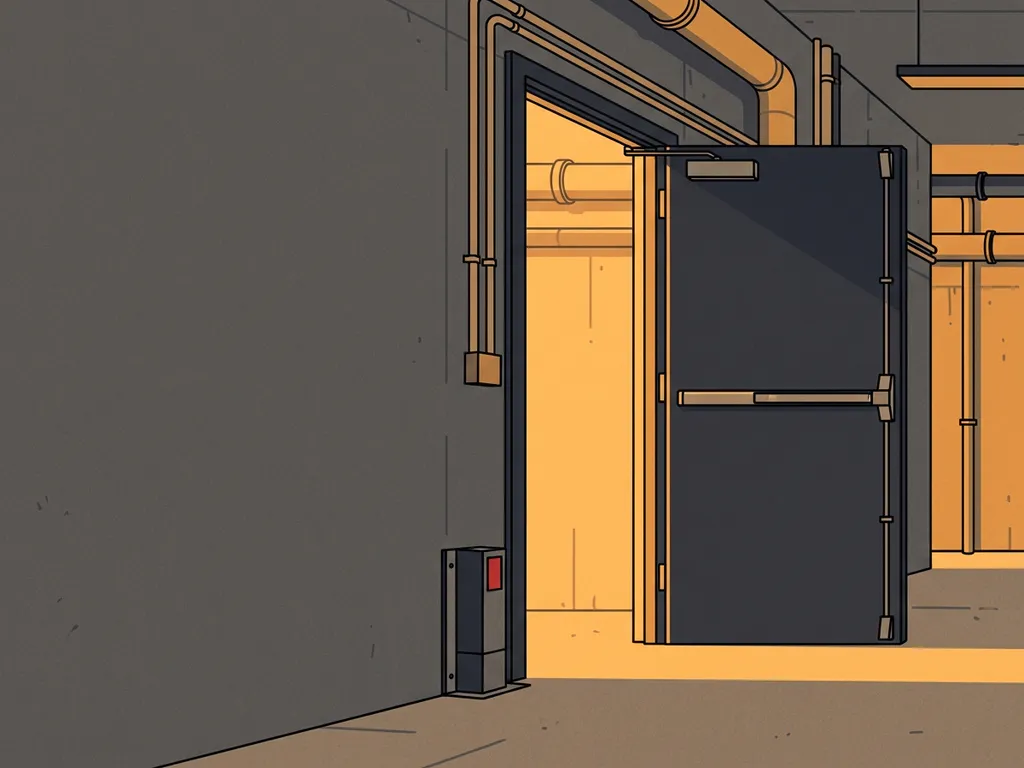
A magnetic hold-open device on a fire door is an electromagnet-based mechanism that holds a self-closing fire door in the open position during normal building operations. When a fire alarm activates, the electromagnet releases, and the door’s integrated closer pulls it shut automatically. This restores fire compartmentation without requiring any manual intervention from building occupants.
The device allows a fire door to serve as an everyday passage opening while guaranteeing that it performs its fire-resisting function the moment it is needed. For architects specifying fire-rated industrial doors in production halls, logistics centres, or healthcare complexes, understanding how these devices work and where they are permitted is essential to producing a compliant, functional design.
How does a magnetic hold-open device actually work?
A magnetic hold-open device consists of an electromagnet mounted on the door or wall and a matching steel plate on the opposite surface. As long as electrical current flows through the magnet, the door is held firmly in the open position. The moment the current is interrupted, the magnetic force disappears instantly, and the door’s self-closing mechanism takes over, pulling the leaf to the closed and latched position.
The electrical current that powers the magnet is connected to the building’s fire detection or alarm system. This integration is what makes the device fire-safe rather than simply convenient. Under normal conditions, the circuit is live and the door stays open. Under alarm conditions, the circuit is broken and the door closes without any human action required.
Most systems are designed to fail safe, meaning that any interruption to the power supply, whether caused by a fire, a power cut, or a wiring fault, results in the door closing. This principle ensures that a technical failure never leaves a fire compartment boundary open.
Why would a fire door need to be held open at all?
Fire doors that close automatically create friction in buildings where people, goods, or vehicles move through them repeatedly throughout the day. In production environments, logistics warehouses, and large industrial facilities, a fire door that swings shut after every passage quickly becomes an operational obstacle. A hold-open device resolves this conflict by allowing the door to remain open during working hours while preserving its fire-resisting function when it counts.
The alternative, wedging a fire door open or removing its closer, is both illegal and dangerous. A door that cannot close when a fire starts fails its only critical purpose. The magnetic hold-open device is the code-compliant solution that satisfies both operational efficiency and fire safety requirements simultaneously.
For architects designing passageways in production halls or warehouses where forklift traffic or continuous pedestrian flow is expected, specifying a hold-open device is often the only way to make a fire-rated opening genuinely usable. Fire-rated industrial doors from Metacon-Next are available with hold-open functionality precisely because this is a common and legitimate requirement in large-scale industrial projects.
What triggers the release of a magnetic hold-open device?
The release of a magnetic hold-open device is triggered by any signal that breaks the electrical circuit powering the electromagnet. In practice, this is almost always the building’s fire detection or alarm system. When a smoke detector, heat detector, or manual call point activates, the alarm panel sends a signal that cuts power to the hold-open device, releasing the door.
Beyond fire alarm activation, several other events can trigger a release:
- Power failure: A complete loss of building power cuts the circuit and releases all connected hold-open devices simultaneously.
- Manual override: Most devices include a manual release button on the unit itself, allowing occupants to close the door intentionally without triggering the alarm.
- Zone-based signalling: In larger buildings, the alarm system may be zoned so that only hold-open devices in the affected compartment release, rather than every door in the building.
The wiring between the alarm panel and the hold-open devices must be specified carefully. In many projects, fire-rated cable is required for this circuit to ensure the signal path remains intact even if the cable runs through an area affected by the fire. This is a detail that belongs in the specification at drawing stage, not as an afterthought during installation.
Are magnetic hold-open devices permitted on all fire doors?
Magnetic hold-open devices are not automatically permitted on every fire door. Their use is subject to the requirements of the applicable standard for self-closing devices, principally EN 1155, which governs electrically powered hold-open devices for fire-resisting doorsets. A door assembly must be tested and classified with the hold-open device included to confirm that the overall assembly still meets its fire resistance classification — expressed per EN 13501-2 as a combination of integrity (E), radiation reduction (W), or insulation (I1 or I2) criteria together with a duration in minutes — when the door closes.
This means the hold-open device must be part of the tested and certified door assembly, not an add-on fitted in the field after the fact. An architect specifying a fire door with hold-open functionality needs to confirm that the manufacturer’s classification report covers the door with that device installed. A hold-open device retrofitted to a door that was not tested with one can invalidate the fire resistance classification of the entire assembly.
There are also installation contexts where hold-open devices may not be appropriate regardless of product certification. Doors in certain high-risk areas, or doors where the applicable fire safety calculation demands that the compartment boundary is always closed, may not be suitable candidates for hold-open functionality. The determination depends on the project-specific fire safety plan and, where relevant, on the fire safety engineer or local authority responsible for that project — not on a blanket rule.
What is the difference between a hold-open device and a door closer?
A door closer is a mechanical device that automatically pulls a fire door shut after each use. A hold-open device is a separate mechanism that counteracts the door closer, keeping the door open until a release signal is received. The two components work together: the door closer provides the closing force that makes the door fire-safe, and the hold-open device temporarily overrides that force during normal operations.
Neither device replaces the other. A fire door with a hold-open device still requires a functioning door closer, because the closer is what actually shuts the door when the electromagnet releases. Without a closer, the door would simply swing free after release and might not close at all, depending on its orientation and the air pressure in the space.
Some fire door assemblies integrate both functions into a single unit, combining the closing mechanism and the electromagnetic hold-open in one component. Whether integrated or separate, both functions must be present and must work in sequence for the assembly to perform correctly under fire conditions. Architects should verify which configuration is covered by the manufacturer’s classification report before specifying either approach.
What should architects check when specifying a hold-open device?
When specifying a magnetic hold-open device on a fire-rated door, architects must verify several technical and regulatory points before the specification is finalised. Missing any of these at drawing stage typically means delays or non-compliance during permitting or inspection.
- Classification scope: Confirm that the fire resistance classification report for the door assembly — issued per EN 13501-2 and tested per EN 1634-1 — explicitly includes the hold-open device. A classification obtained without the device does not cover the assembly as installed. Note that the classification will specify whether the door meets E, EW, EI1, or EI2 criteria: always verify which criterion and duration apply to your project, as this depends on the project-specific fire safety calculation.
- EN 1155 compliance: The hold-open device itself must comply with EN 1155. Request the product declaration from the manufacturer.
- Alarm system integration: Specify the interface between the hold-open device and the fire detection system. Confirm the signal type, voltage, and wiring requirements with both the door manufacturer and the alarm system designer.
- Cable specification: Determine whether fire-rated cable is required for the circuit between the alarm panel and the hold-open devices, based on the routing and the applicable national or project requirements.
- Manual release: Confirm that the device includes a manual release function and that this is accessible to building occupants without tools.
- Fail-safe configuration: Verify that the device is wired to release on power loss, not to hold on power loss.
- CE marking: For industrial fire doors, two CE-marking standards apply simultaneously — EN 16034 (fire- and smoke-resisting closing element) and EN 13241 (industrial door, general). Confirm that both are covered in the manufacturer’s documentation.
Full technical documentation is non-negotiable at specification stage. Manufacturers who publish their classification reports, CE declarations, and installation requirements openly make this process significantly faster. Metacon-Next publishes complete technical documentation for its certified fire door range, including products available with hold-open functionality, so architects can verify compliance without waiting for a sales response.
For projects where the specification needs to be closed quickly and completely, the ability to download classification reports, technical drawings, and EPDs directly, without requesting them by email, is a practical advantage that reduces risk and saves time. If you are working on a project that requires fire-rated industrial doors with hold-open capability, request a quotation or contact the team to confirm which configurations are available for your opening dimensions and fire resistance classification.
Related Articles
- How do insurers assess fire door compliance in industrial buildings?
- How is fire compartmentation achieved in a large warehouse?
- Who is certified to install fire-rated industrial doors?
- How does an automatic fire door work in a production environment?
- How do you determine the right fire resistance class for your project?